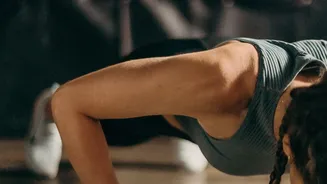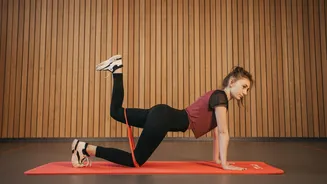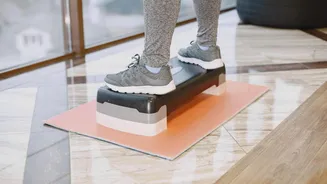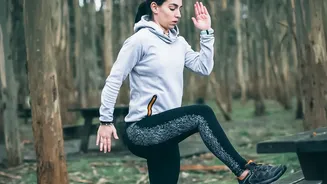





As winter sets in, finding the motivation for outdoor exercise can be tough. Fortunately, a powerful and simple workout is waiting for you right at home. Step-ups are an accessible way to stay fit, requiring minimal space and equipment.
Why Choose Step-Ups?
The step-up is
a highly effective, low-impact exercise that offers a wealth of benefits. As a compound movement, it engages multiple muscle groups simultaneously, including the quadriceps, hamstrings, glutes, and even your core. This makes it an efficient way to build lower-body strength and stability. One of the key advantages of step-ups is that they are a unilateral exercise, meaning they work one leg at a time. This helps to identify and correct strength imbalances between your legs, which can improve overall coordination and reduce the risk of injury. Furthermore, step-ups can be a fantastic cardio workout. By increasing the pace, you can elevate your heart rate, boosting cardiovascular health and burning calories without having to brave the cold.
Mastering the Perfect Form
Proper form is crucial to maximise benefits and prevent injury. All you need is a sturdy, non-slip surface like a staircase step, an aerobic step, or a stable box. The ideal height is one where your knee is at roughly a 90-degree angle when you place your foot on it. To begin, stand tall in front of your step. Place your entire right foot firmly on the platform. Engage your core and keep your chest lifted and back straight. Press through your right heel to lift your body up, bringing your left foot to meet the right on the step. The power should come from your front leg, not from pushing off with your back foot. To descend, step back down with your left foot first, followed by your right, returning to the starting position with control. You can complete all repetitions on one side before switching or alternate legs with each rep.
Common Mistakes to Avoid
To get the most out of your workout, be mindful of a few common errors. The most frequent mistake is pushing off with the trailing leg on the floor. This takes the load off the working leg, reducing the exercise's effectiveness. Focus on pulling your body up with the leg on the step. Another error is choosing a step that is too high. This can cause you to lean too far forward or compromise your form, putting unnecessary strain on your back. Always ensure your knee on the stepping leg tracks in line with your toes and does not collapse inward. Finally, avoid dropping down quickly. The controlled downward phase, or eccentric portion of the movement, is just as important for building strength.
Variations for Every Fitness Level
One of the best things about step_ups is their versatility. They can be easily modified to suit any fitness level. For beginners, starting with a lower step height is a great way to build confidence and perfect the form. As you get stronger, you can increase the challenge in several ways. Increasing the height of the step will place more emphasis on your glutes and hamstrings. You can also add weight by holding dumbbells at your sides or a kettlebell at your chest. For a greater cardiovascular challenge, increase your speed. More advanced variations include the lateral step_up, which targets the inner and outer thighs, or a step_up with a knee drive at the top to enhance hip power and mimic athletic movements like sprinting.
Creating a Simple Winter Workout
Step_ups can be a standalone workout or part of a larger indoor circuit. For a focused lower_body session, aim for 3 sets of 10–15 repetitions on each leg, adjusting the numbers based on your fitness level. To create a full–body routine, you can pair step–ups with other bodyweight exercises. For example, you could perform a circuit of step–ups, push–ups, planks, and squats. This combination ensures you are working all major muscle groups for a balanced and effective workout. Consistency is key, especially during the winter months when activity levels tend to drop. By incorporating this simple yet powerful exercise into your weekly routine, you can maintain your fitness and energy levels until spring arrives.