

A Sweet Delivery From Space
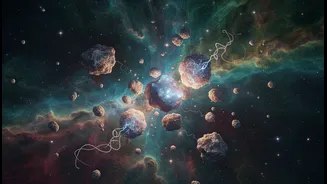
The story begins not in a primordial soup on Earth, but inside ancient rocks that have journeyed through space for billions of years. An international team of scientists made a breakthrough discovery by analyzing carbon-rich meteorites, specifically two
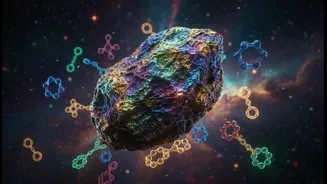
named NWA 801 and Murchison. Tucked away inside these cosmic time capsules, they found something remarkable: bio-essential sugars. These weren't just any sugars, but included ribose, arabinose, and xylose—key components for life as we know it. Previously, researchers had found other building blocks of life like amino acids (the components of proteins) and nucleobases (parts of DNA and RNA) in meteorites, but sugars had been the missing piece of the puzzle. This was the first direct evidence of ribose, a particularly crucial sugar, being found in space. The discovery added significant weight to the hypothesis that asteroids, the parent bodies of these meteorites, can act as factories for life's ingredients.
The Sugar-Coated Blueprint of Life
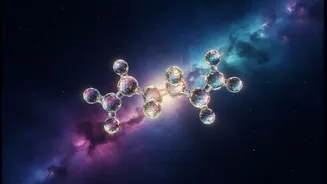
So why is finding ribose such a big deal? Because it’s the central component of RNA, or ribonucleic acid. This has major implications for a leading theory on the origin of life known as the "RNA World" hypothesis. This theory proposes that before the emergence of DNA and proteins, life was based on RNA. In this primitive world, RNA molecules would have performed the dual roles of storing genetic information (like DNA does today) and catalyzing chemical reactions (a job now mostly done by proteins). For this to have been possible, there needed to be a ready supply of ribose on the early Earth. The problem is that forming sugars like ribose under the conditions of a young planet is difficult and the molecules themselves are quite fragile. The discovery of pre-formed ribose in meteorites offers a compelling solution: perhaps the sugar didn't need to form on Earth at all, but was delivered ready-made by a constant bombardment of meteorites.
Confirming a Cosmic Origin
Whenever scientists find biological molecules in meteorites, the first question is always: is it just contamination from Earth? Our planet is teeming with life, and these molecules are everywhere. To rule this out, the research teams performed careful isotope analysis. They measured the ratio of a heavier carbon variant, carbon-13, in the meteorite sugars. Molecules formed in space tend to have more carbon-13 than their terrestrial counterparts. The analysis showed the sugars were enriched with carbon-13, strongly indicating they were of extraterrestrial origin and not simply contamination from our own biosphere. Further evidence comes from pristine samples returned directly from asteroids, such as NASA’s OSIRIS-REx mission to the asteroid Bennu. Analysis of these samples, which never touched Earth's surface until they were safely in a lab, also revealed the presence of sugars like ribose and glucose, confirming that these molecules are indeed widespread in our solar system.
Beyond Meteorites to Interstellar Space
Recent discoveries have pushed the origin of these cosmic sugars even further back in time and space. In July 2026, astronomers announced the first-ever detection of a true sugar, called erythrulose, in the interstellar medium—the vast clouds of gas and dust that exist between stars. This particular sugar was found in a molecular cloud near the center of the Milky Way, some 27,000 light-years away. This finding is crucial because it shows that biologically relevant sugars can form before asteroids and planets even begin to coalesce. These interstellar clouds are the very nurseries from which new solar systems are born. This suggests that the chemical ingredients for life aren't just limited to our own celestial neighborhood; they are likely common throughout the galaxy, waiting to be incorporated into newly forming planets.