




A New Polygon on the Block
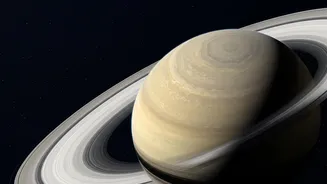
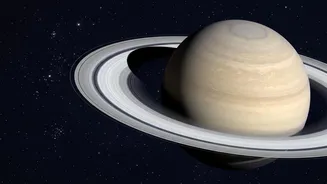
Scientists using NASA's Hubble Space Telescope, aided by a network of amateur astronomers, have confirmed the presence of a giant, 10-sided atmospheric wave circling Saturn's south pole. The discovery, announced in early September 2026, marks the first
time a large, regular-sided jet stream pattern has been seen in the planet's southern hemisphere. This newfound "decagon" is enormous, estimated to be about 104,000 miles (nearly 168,000 kilometers) wide. Unlike the long-observed northern hexagon, this southern feature appears to be a recent development. Researchers traced its origins back to Hubble images from 2023, where it appeared as a faint structure before becoming more defined in subsequent years. The timing is partly due to Saturn's long seasons; its south pole only recently tilted back into Earth's view after being hidden for years.
A Tale of Two Poles
For over 40 years, the northern hexagon has been a stable, perplexing feature, first spotted by the Voyager probes in the early 1980s. Its sides are about 9,000 miles (14,500 km) long, and the entire structure rotates with the planet. For decades, scientists wondered why no similar shape existed at the south pole. NASA's Cassini spacecraft, which orbited Saturn from 2004 to 2017, mapped the south pole extensively and found a massive hurricane-like vortex, but no persistent polygon. This new decagon is fundamentally different. It appears to be a developing phenomenon, giving scientists a rare, real-time look at how such a colossal weather system forms. This suggests the conditions in Saturn's atmosphere can create these geometric waves in both hemispheres, making the hexagon seem less of a one-off fluke.
The Science of Planetary Shapes
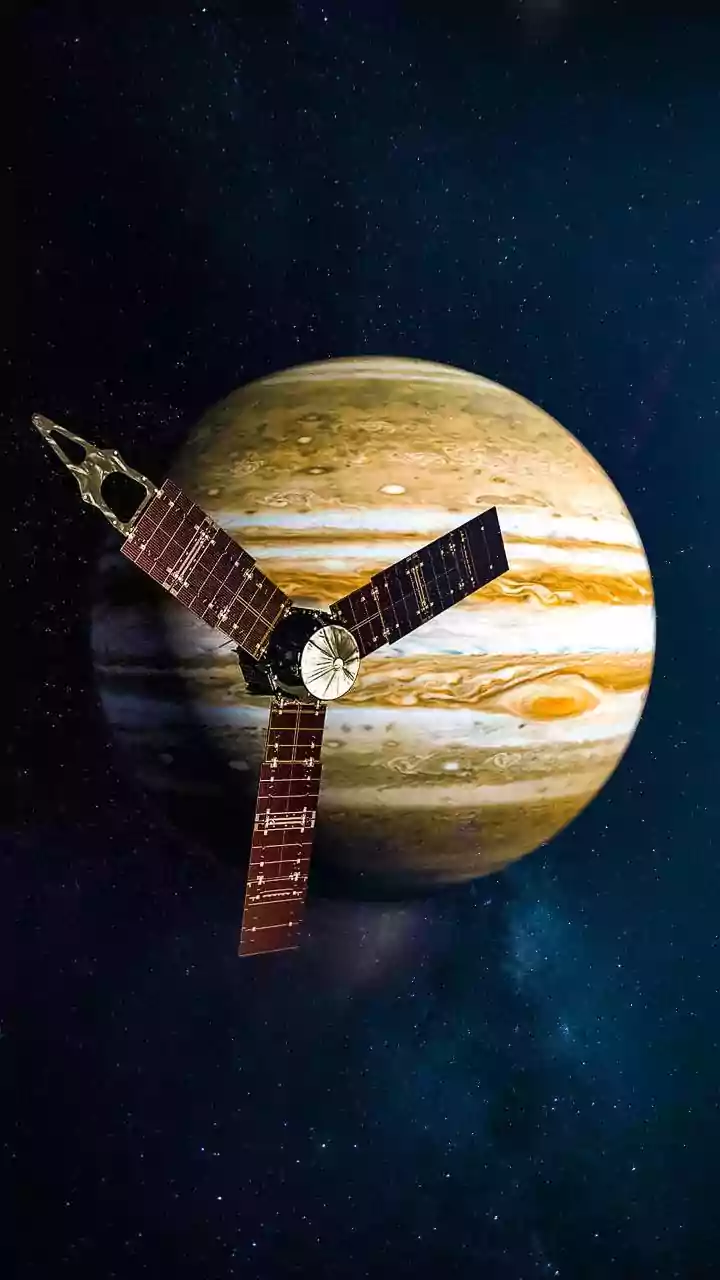
So, how does a planet's atmosphere create a ten-sided storm? The leading theories for these planetary polygons involve powerful jet streams. On Saturn, winds can reach tremendous speeds, and these jet streams can be forced into wave-like, geometric patterns by various atmospheric disturbances. Laboratory experiments on Earth, using rotating tanks of liquid, have successfully recreated hexagonal and other polygonal shapes by creating different rotational speeds within the fluid. Scientists believe the northern hexagon is a standing wave in a powerful eastward jet stream. The new southern decagon, however, may have a different cause. Some researchers theorize it's linked to a meandering wave or is being influenced by a nearby high-pressure vortex, an anticyclone that resembles a smaller version of Jupiter's Great Red Spot.
A Puzzle Wrapped in a Vortex
The discovery of the decagon raises more questions than it answers. Why ten sides instead of six? Why did it form only now, years after the Cassini mission ended? The decagon is not just a surface feature; analysis shows the wave structure extends deep into multiple layers of Saturn's atmosphere. It's also located at a different latitude than its northern counterpart. Scientists are eager to see how it evolves. The northern hexagon has remained incredibly stable for decades, whereas this southern polygon is a newborn by comparison. Observing whether the decagon stabilizes, grows stronger, or dissipates will provide invaluable data on the physics that govern the atmospheres of gas giants. As lead researcher Agustín Sánchez-Lavega noted, it's a very unusual phenomenon that advances our general understanding of meteorology.