



The Sky-High Cost of Lunar Construction
Establishing a permanent base on the Moon is a monumental undertaking. Beyond the technological challenges of life support and transportation, the sheer logistics of construction are staggering. Every kilogram of material launched from Earth costs thousands
of dollars, making the prospect of shipping steel, concrete, and heavy machinery across 250,000 miles a logistical and financial nightmare. Studies have suggested that building with materials brought from Earth could consume up to 90% of the payload capacity on missions, leaving little room for scientific instruments, life support, or the astronauts themselves. For a sustainable, long-term presence to be practical, space agencies like NASA and the European Space Agency (ESA) agree that we can't just pack everything we need. We have to learn to live off the land.
Building with Moon Dust
The solution lies in a concept called In-Situ Resource Utilization (ISRU), which is a fancy way of saying 'using what's already there'. The Moon's surface is covered in a thick layer of fine, grey powder called regolith. Formed over billions of years by micrometeorite impacts, this 'moon soil' is abundant and rich in useful elements like silicon, aluminium, iron, and oxygen. Instead of hauling tonnes of building supplies from Earth, space agencies are developing methods to turn this plentiful dust into a durable construction material. This approach dramatically reduces launch costs and is the only feasible path toward building the landing pads, roads, habitats, and radiation shields needed for a permanent lunar colony.
Meet the Robotic Construction Crew
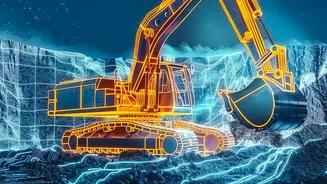
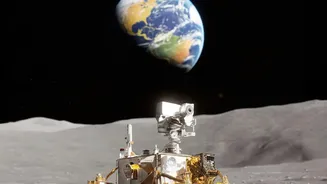
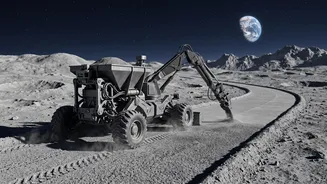
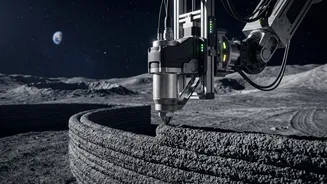
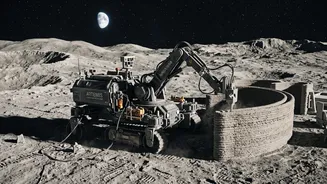
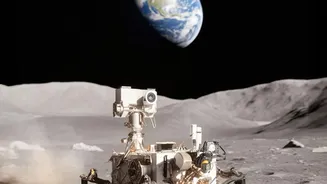
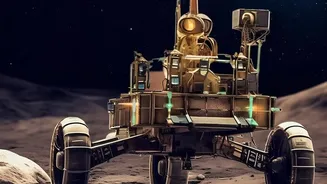
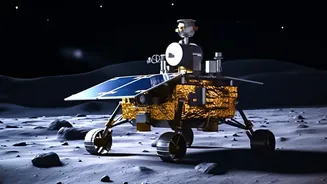
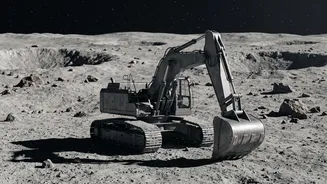
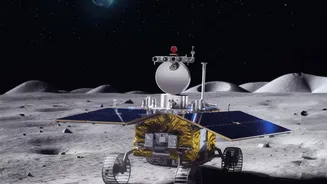
Humans are ill-suited for the harsh construction environment of the Moon, with its extreme temperatures, radiation, and abrasive dust. That's a job for robots. Fleets of autonomous machines are being designed to work as a coordinated team. These robotic crews will perform every stage of the construction process. Surveyor rovers equipped with LiDAR will scan and map building sites, while other robots will clear and level the ground. Excavators will gather the regolith, and mobile processing plants will filter it to get the right particle consistency. Finally, large-scale 3D-printing robots will get to work, building structures layer by layer. The key is autonomy; with significant communication delays between Earth and the Moon, these robots must be able to perform their tasks and solve problems with minimal human intervention.
From Soil to Solid Structures
So, how do you turn loose dust into a solid building? The leading method is a form of 3D printing called sintering. This process involves heating the regolith to just below its melting point, causing the particles to fuse together into a solid, ceramic-like material. Several techniques are being tested. Some use powerful lasers to melt the regolith in precise patterns, layer by layer, to form walls and structures. The European Space Agency's PAVER project has successfully demonstrated using a high-power laser to create interlocking, paved surfaces from simulated moondust. Another promising method is microwave sintering, which could offer a more energy-efficient way to create strong, concrete-like blocks. Companies like ICON, under contract with NASA for its 'Project Olympus', are developing advanced 3D printing systems to turn these concepts into reality, aiming to build humanity's first structure on another world.
Challenges in a Vacuum
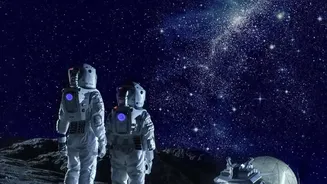
Building on the Moon is not without its difficulties. Lunar regolith is not like terrestrial sand; its particles are sharp, jagged, and abrasive, which can wreak havoc on machinery. The extreme temperature swings, from scorching hot to freezing cold, and the vacuum of space also create a difficult engineering environment. Furthermore, the construction process itself is complex. The robots must be able to handle inconsistent materials and function flawlessly in a dusty, low-gravity setting. Despite these hurdles, using thick regolith-based walls has a major advantage: it provides excellent protection against the dangers of cosmic radiation and micrometeorite impacts, creating safe shelters for future lunar inhabitants.