






The Case for Robots: The Pragmatic Pioneer
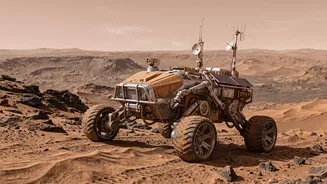
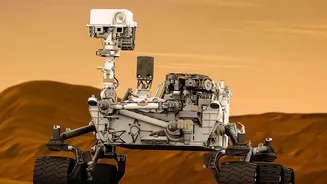
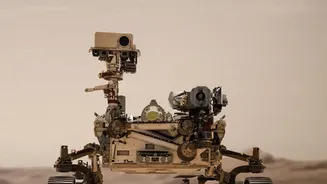
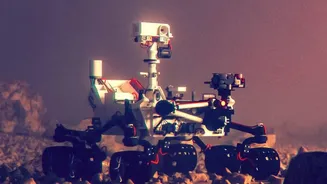
Sending robots to Mars is, by every practical measure, the easier, cheaper, and safer option. Robotic missions, like the Perseverance rover, cost a fraction of their human-led counterparts. A crewed mission's price tag can soar into the hundreds of billions,
while a robotic one might cost under $3 billion. The reason is simple: robots don't need food, water, oxygen, or a return ticket. They don't require heavy, complex life-support systems or extensive shielding to protect them from the harsh radiation of deep space. Robots can be designed to withstand extreme temperatures and environments that would be lethal to a human. They can operate for years, methodically collecting data long after their initial landing. This makes them ideal for the initial phases of exploration: mapping terrain, analyzing the atmosphere, and searching for resources like water ice, all of which are critical for planning future human missions. They are our indispensable robotic scouts, paving the way and reducing the risks for those who might follow.
The Human Advantage: Unmatched Adaptability
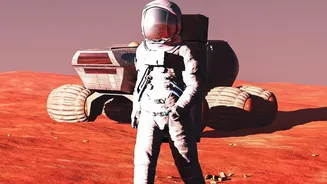
For all their resilience, robots are limited by their programming. They move slowly and struggle with unexpected challenges. A rover might take over a decade to cover the same distance an Apollo astronaut covered in a few days on the Moon. This is where the human advantage becomes clear. Astronauts are the ultimate problem-solvers. They possess intuition, creativity, and the ability to make complex, on-the-spot decisions. If a piece of equipment fails or an unexpected geological formation appears, a human can immediately adapt, investigate, and troubleshoot in ways a remote-controlled robot cannot. The scientific return can be exponentially greater. Human explorers can collect more samples, conduct more sophisticated experiments, and follow scientific hunches in real-time. Sending people to Mars is not just about planting a flag; it’s about leveraging the unique cognitive abilities that have driven human discovery for millennia. It also serves as a powerful inspiration, encouraging new generations to pursue science and technology.
The Harsh Reality of a Human Mission
The challenges of sending humans to Mars are monumental. The journey alone takes six to nine months each way, exposing astronauts to dangerous levels of cosmic radiation that increase cancer risk. Prolonged exposure to microgravity causes muscle atrophy and bone density loss. Once on Mars, the lack of a global magnetic field and a thin atmosphere means the radiation hazard continues. Beyond the physical toll, there are immense psychological pressures of being isolated in a small habitat for up to three years, millions of miles from Earth. Then there are the technical hurdles. A human mission requires a vehicle capable of not only landing a heavy payload safely on Mars—a feat that is already incredibly difficult—but also launching it back off the planet for the return journey. Every system, from life support to communication, must be flawlessly reliable, as there is no possibility of a quick rescue.
A Hybrid Future: Not 'Vs' but 'And'
The debate over robots versus humans is increasingly seen as a false choice. The future of Mars exploration lies in their synergy. NASA’s strategy, often dubbed 'Moon to Mars', envisions a model where robotic and human efforts are deeply integrated. Robots are the precursors, sent ahead to assess risks, identify resources, and even begin preparing infrastructure. Envision a future where humanoid robots perform dangerous or repetitive tasks like setting up habitats, maintaining equipment, or exploring hazardous terrain, freeing up human astronauts to focus on complex scientific research. This human-machine teaming is seen as vital to creating a sustainable presence on the Moon and, eventually, Mars. Astronauts could telerobotically operate rovers in real-time from orbit or a nearby habitat, combining human intellect with robotic resilience. This approach leverages the strengths of both, mitigating the weaknesses of each and making the monumental task of exploring another world safer and more efficient.