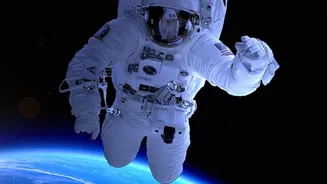







A Personal Atmosphere for Breathing
The most critical function of a spacesuit is to provide a breathable atmosphere. In the vacuum of space, an unprotected person would lose consciousness in seconds. Spacesuits solve this by creating a pressurised environment filled with pure oxygen. This
oxygen is supplied from a backpack, formally known as the Primary Life Support System (PLSS). This system not only feeds fresh oxygen into the helmet for the astronaut to breathe but also includes a crucial filtration system. As an astronaut exhales carbon dioxide, canisters containing materials like lithium hydroxide capture and scrub it from the air, preventing a toxic buildup within the suit. A fan constantly circulates this purified air, ensuring a steady flow of breathable oxygen.
Staying Cool in Extreme Temperatures
Space temperatures are a story of extremes, swinging from a scorching 120°C in direct sunlight to a frigid -150°C in the shade. A spacesuit is designed to be highly reflective (which is why they are white) and heavily insulated to shield the astronaut from these swings. However, the real challenge is getting rid of the astronaut's own body heat. Inside the insulated suit, an astronaut’s body can get dangerously hot just from the effort of moving around. The ingenious solution is a Liquid Cooling and Ventilation Garment (LCVG). This is essentially a set of long underwear woven with a network of fine plastic tubes. Cool water circulates through these tubes, pulling heat away from the astronaut’s skin. The warmed water then flows back to the PLSS backpack, where the heat is radiated out into space before the chilled water is sent back through the suit.
A Multi-Layered Shield Against the Void
Beyond air and temperature, a spacesuit must protect against the vacuum itself and other hazards. The suit is comprised of multiple layers, each with a specific job. The innermost layers include the cooling garment, followed by a rubbery, balloon-like 'bladder' layer that holds the pressurised oxygen. A restraint layer on top of this gives the suit its shape and prevents the bladder from inflating uncontrollably. Without this pressure, bodily fluids would boil in the vacuum of space. The outer layers form the Thermal Micrometeoroid Garment. This section consists of multiple layers of tough, heat-resistant materials like Kevlar, Nomex, and Mylar, which act as a shield. These layers can stop tiny but incredibly fast-moving particles of space dust and rock from puncturing the suit, which could be catastrophic.
Mobility and Vision in a Pressurised Bubble
While providing total protection, a spacesuit must also allow the astronaut to move, work, and see. Moving inside a pressurised suit is difficult, often compared to squeezing a balloon; every movement is resisted by the internal pressure. Suit designers use special bearings and flexible joints to give astronauts a reasonable range of motion in their arms and legs. The helmet is another key component, made from impact-resistant polycarbonate. It provides a wide field of view and is topped with a special visor coated with a thin layer of gold. This coating acts like a powerful pair of sunglasses, reflecting the sun's harsh ultraviolet and infrared radiation to protect the astronaut’s eyes.