



A Once-in-a-Lifetime Celestial Show
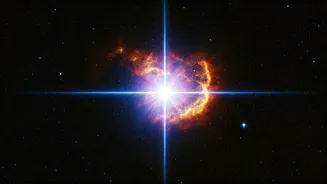
Sometime in 2024, a faint star system 3,000 light-years away will erupt in a spectacular explosion known as a nova. This event, involving a star called T Coronae Borealis (T CrB), will become so bright that it will be visible to the naked eye from Earth
for several days. For stargazers in India and across the Northern Hemisphere, it will appear as if a brand new star has suddenly joined the heavens. T CrB, nicknamed the 'Blaze Star', is what astronomers call a recurrent nova. Most novae are a one-time event, but T CrB puts on this show roughly every 80 years. The last time it flared up was in 1946, a time before India’s independence and long before the advent of modern space telescopes. This makes the 2024 outburst a truly once-in-a-generation opportunity to witness a predictable, yet powerful, cosmic cataclysm with our own eyes.
The Violent Dance of Two Stars
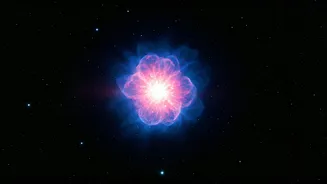
So, what exactly is happening 3,000 light-years away? T Coronae Borealis isn't a single star but a binary system—two stars locked in a gravitational dance. One is a red giant, an old, bloated star nearing the end of its life. The other is a white dwarf, the super-dense, collapsed core of a long-dead star. The white dwarf is a cosmic vampire. Its immense gravity continuously pulls hydrogen gas from the outer layers of its larger red giant companion. This stolen material accumulates on the white dwarf's surface, forming a dense, hot layer. Over decades, the pressure and temperature in this layer build up until they reach a critical point, triggering a runaway thermonuclear explosion. This is the nova. It's not the star itself exploding (that would be a supernova), but rather a massive burst of energy from its surface that ejects the accumulated material into space, causing the system to brighten by a factor of thousands.
A Triumph of Cosmic Prediction
Perhaps the most fascinating part of this story is that we know it’s coming. Astronomers have been watching T CrB for decades, studying its patterns. Based on its last eruption in 1946 and a noticeable dimming event observed in 2023—a known precursor to its outburst—scientists are confident the next nova is imminent. This prediction is a testament to the power of long-term observation and our understanding of stellar physics. It transforms a random celestial event into a scheduled performance. By knowing the 80-year cycle and spotting the tell-tale pre-eruption dimming, agencies like NASA can alert the global community of amateur and professional astronomers. This isn't just about watching a pretty light; it's about scientists testing and proving their models of how the universe works, turning a cosmic mystery into a predictable phenomenon.
How to Spot the 'New' Star
When the nova occurs, you won't need a telescope to see it. T CrB will shine at a magnitude of +2, similar to Polaris, the North Star. To find it, you'll need to locate the constellation Corona Borealis, or the 'Northern Crown'—a small, C-shaped arc of stars. It's nestled between the larger constellations of Boötes (with its bright star Arcturus) and Hercules. From most of India, this constellation is visible in the evening sky through the summer months, rising in the northeast and arcing overhead. The nova will appear as a temporary bright point within this 'C' shape. Once it erupts, it will be at peak brightness for only a few days before gradually fading back into obscurity over the following week, not to be seen again until the 22nd century. Several astronomy apps for your phone can help you locate Corona Borealis easily. The key is to be ready, as the exact date is uncertain, but the window is widely expected to be between now and September 2024.