

The Challenge of a Veiled Planet
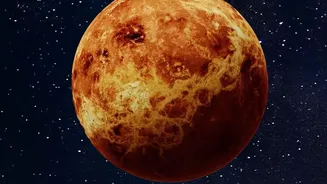
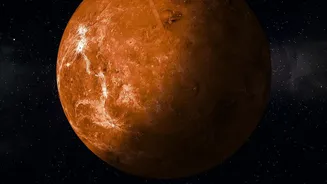
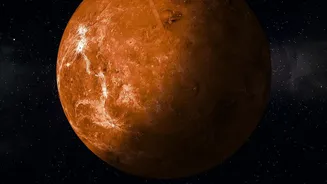
Studying Venus has always been incredibly difficult. Its surface is completely hidden by a dense global cloud cover made of sulfuric acid. This isn't like the fluffy water clouds on Earth; it's a permanent, opaque blanket that reflects about 75% of sunlight,
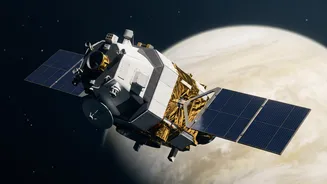
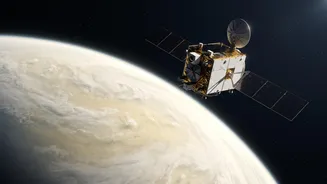
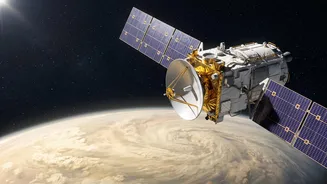
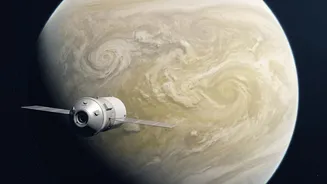
making it impossible for traditional optical telescopes to see the surface. The atmosphere itself is about 92 times denser than Earth's and consists mainly of carbon dioxide, which has created a runaway greenhouse effect. This traps heat, raising surface temperatures to a scorching 460°C, hot enough to melt lead. The immense pressure is equivalent to being a kilometer deep in our oceans. Any spacecraft attempting to land survives for only a couple of hours at most before being crushed and cooked. It’s this hellish environment that Shukrayaan-1, an orbiter mission, is built to overcome from a safe distance.
The Power of Seeing with Radar
The primary tool ISRO will use to bypass the thick Venusian clouds is a high-resolution Synthetic Aperture Radar (SAR). Unlike a camera that captures visible light, a radar is an active sensor. It works by transmitting its own radio waves towards the planet's surface and then catching the signals that bounce back. Because these microwave signals have a longer wavelength than visible light, they can easily penetrate clouds, haze, and darkness. This allows SAR to create detailed images of the terrain day or night, regardless of the weather conditions. This technology is the key to mapping the surface of Venus, revealing the geology that has remained hidden from us for so long.
Shukrayaan's High-Tech Eyes
The flagship instrument on Shukrayaan-1 is its S-band Synthetic Aperture Radar, an advancement on the technology ISRO successfully used on its Chandrayaan-2 mission to the Moon. This SAR is designed to provide images with a resolution four times better than NASA’s Magellan mission in the 1990s, which gave us our first detailed maps of Venus. This enhanced clarity will allow scientists to investigate surface processes, search for signs of active volcanoes, study lava flows, and map impact craters in unprecedented detail. In a groundbreaking first for Venus exploration, the mission will also carry a ground-penetrating radar. This instrument will probe beneath the surface, allowing scientists to study the shallow subsurface stratigraphy, or rock layers, for the first time.
More Than Just a Surface Map
While penetrating the clouds to see the surface is a primary goal, Shukrayaan-1 is a comprehensive mission designed to study the entire Venusian system. The orbiter will carry a suite of 19 payloads, including contributions from international partners like Russia, France, Sweden, and Germany. Instruments will analyze the complex and dynamic atmosphere, investigating the mysterious 'super-rotation' where winds circle the planet far faster than it spins. A key international payload is the Venus Infrared Atmospheric Gases Linker (VIRAL), co-developed by France and Russia. It will study the atmospheric composition, including looking for gases like phosphine, which some scientists have controversially suggested could be a possible indicator of life in the upper cloud layers. Other instruments will study how the Venusian ionosphere interacts with the constant stream of particles from the sun, known as the solar wind.