





The Dawn of Commercial Space Stations
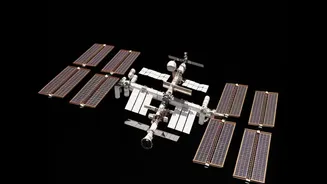
For over two decades, the International Space Station (ISS) has been the primary destination for humanity in low Earth orbit. However, with the ISS slated for retirement around 2030, a new space race is heating up. This time, it's not between nations,
but among private companies vying to build the next generation of orbital platforms. Firms like Axiom Space, Sierra Space, and Vast are developing commercial space stations intended to serve a diverse clientele, including national space agencies, private astronauts, and, crucially, scientific researchers. These ventures aim to create a robust economy in low Earth orbit, and advanced research is at the heart of their business model.
The Inflatable Advantage
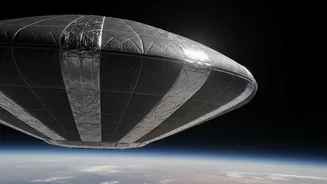
Building in space is extraordinarily expensive, largely due to the constraints of launching hardware on rockets. Every kilogram and cubic metre of payload volume comes at a premium. This is where inflatable, or expandable, habitats offer a revolutionary advantage. These structures are launched in a compact, folded state and are then inflated in orbit to their full size. The result is a much larger habitable and usable volume for a given launch mass compared to traditional rigid, metallic modules. Think of it as packing a large tent for a camping trip instead of hauling a pre-built cabin. This efficiency dramatically reduces launch costs while maximizing the potential for living quarters, storage, and vital laboratory space.
Leading the Pack with Soft Goods
Several companies are at the forefront of this technology. Sierra Space is developing its Large Integrated Flexible Environment (LIFE) habitat, a key component of the proposed Orbital Reef space station it is planning with Blue Origin. These modules are designed to house astronauts and provide ample room for science experiments, a medical center, and even a greenhouse. The technology builds on a long history, including NASA's TransHab concept from the 1990s and the Bigelow Expandable Activity Module (BEAM), which has been successfully tested on the ISS since 2016. While Bigelow Aerospace has since ceased operations, its pioneering work proved the viability of using advanced, multi-layered fabrics like Vectran—a material stronger than steel—to create safe and durable structures in space.
A New Frontier for Science
The primary purpose of these new commercial stations is to provide unprecedented access to a unique laboratory environment: microgravity. The persistent low-gravity conditions in orbit allow for research that is impossible on Earth, with potential breakthroughs across numerous fields. Scientists will be able to conduct advanced experiments in materials science, developing new alloys and semiconductors. In pharmaceuticals and biology, researchers can grow purer protein crystals for drug development and study cellular processes without the masking effects of gravity. Other promising areas include bioprinting tissues and organs, fluid physics, and combustion science. These private stations will offer dedicated, state-of-the-art facilities, like plate readers and remotely operated labs, to make space-based research more accessible and efficient than ever before.
Building the Orbital Economy
While inflatable technology provides a path forward, the road to a bustling orbital economy still has challenges. Companies must navigate complex safety certifications, secure massive funding, and prove there is a sustainable market for their services beyond NASA. Axiom Space is taking a phased approach, initially attaching its modules to the ISS before detaching to become a free-flying station as early as 2028. Vast plans to launch its first standalone station, Haven-1, in the coming years. The success of these ventures will depend on attracting a wide range of customers for research, manufacturing, and even tourism, creating a self-sustaining ecosystem that ensures a continuous human presence in low Earth orbit.