

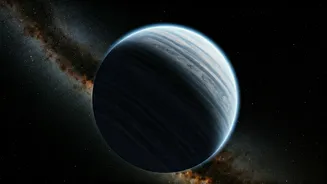


A Breakthrough Discovery in an Alien Atmosphere
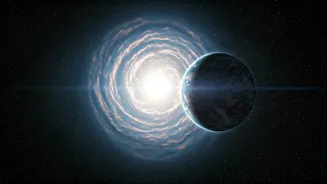
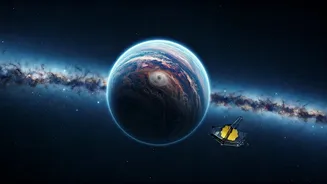
Astronomers using the James Webb Space Telescope (JWST) have confirmed the presence of water vapour in the atmosphere of an exoplanet named K2-18b, located 124 light-years from Earth. This planet is what's known as a 'super-Earth,' weighing about 8.6
times the mass of our own world. The detection was made by analysing starlight that filtered through the planet’s atmosphere, which allowed scientists to identify the chemical fingerprints of various molecules. This finding is significant because K2-18b orbits within its star's 'habitable zone' — the region where temperatures could be just right for liquid water to exist.
From Water Vapour to Water Worlds
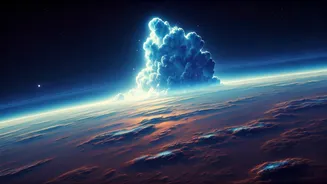
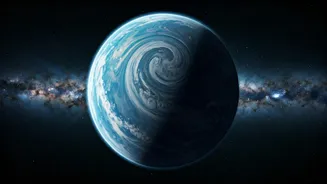
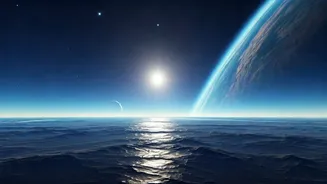
The headline-grabbing phrase is 'alien oceans,' and K2-18b is a prime candidate for a new, theoretical class of planet called a 'Hycean' world. The name, a blend of 'hydrogen' and 'ocean,' describes a planet covered by a deep, global ocean of liquid water, with a thick hydrogen-rich atmosphere. The presence of both water vapour and methane, as detected by JWST, aligns with the predictions for such a world. If K2-18b is indeed a Hycean planet, it would dramatically expand the types of worlds astronomers consider potentially habitable, as these planets can be larger and hotter than Earth and still sustain liquid oceans.
The Search for Biosignatures
Finding water is one thing, but finding life is another. The most electrifying part of the recent observations is the potential detection of a molecule called dimethyl sulfide (DMS). On Earth, DMS is overwhelmingly produced by life, specifically marine life like phytoplankton. Finding it on another world is a tantalising hint, but scientists are cautious. The signal is still being verified, and researchers are exploring whether non-biological processes could produce DMS in K2-18b's unique environment. It’s not proof of alien life, but it's the most promising potential biosignature found to date.
A Dose of Scientific Caution
It’s crucial to distinguish between exciting possibilities and confirmed facts. While the idea of a life-filled ocean on K2-18b is compelling, there are other interpretations of the data. Some scientists argue that K2-18b might not be a water world at all, but rather a gaseous 'mini-Neptune' with no solid surface or a world with a scorching magma ocean. Even if there is an ocean, the planet's large mass means its surface gravity would be much stronger than Earth's. The debate is a healthy part of the scientific process, and more observations are needed to confirm the true nature of this distant world.
Why This Matters for India and the World
This discovery, made possible by an international collaboration with the JWST, resonates with the global spirit of scientific exploration. For India, a nation with a proud and ambitious space program through ISRO, such findings are a source of inspiration. The quest to understand our place in the universe is universal. Discoveries like the one on K2-18b reinforce the importance of investing in science and technology, pushing the boundaries of human knowledge, and inspiring the next generation of scientists and astronomers everywhere to keep looking up at the sky and asking the big questions.