





Meet the 'Steam World' GJ 9827 d
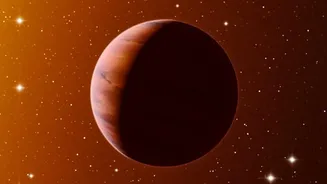
The planet in question, known as GJ 9827 d, is located about 97 light-years away in the constellation Pisces. It's classified as a 'super-Earth' because it's larger than our planet—about twice the diameter—but not a gas giant like Jupiter or Neptune.
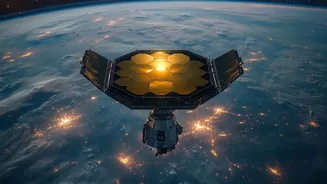
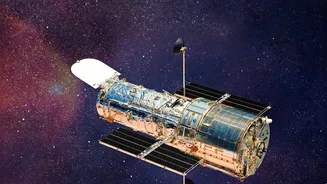
It orbits incredibly close to its star, completing a full year in just over six Earth days. This proximity makes it intensely hot, with temperatures soaring to around 425 degrees Celsius, comparable to Venus. The Hubble Space Telescope had previously found tantalizing hints of water in its atmosphere, but the superior power of the JWST has now confirmed its presence in significant amounts, leading scientists to nickname it a 'steam world.'
How Webb Gazes into Alien Atmospheres
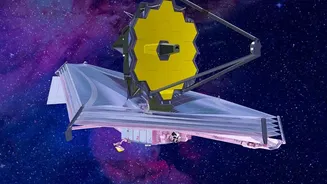
Detecting what an atmosphere is made of from nearly 100 light-years away is a monumental feat of engineering. Astronomers use a technique called transmission spectroscopy. When GJ 9827 d passes in front of its host star from our perspective, a tiny fraction of the starlight filters through the planet's atmosphere. The JWST's highly sensitive instruments, like the Near-Infrared Imager and Slitless Spectrograph (NIRISS), analyze this light. Different chemical elements and molecules absorb light at specific wavelengths, leaving a unique barcode-like signature. By reading this signature, scientists can identify the components of the atmosphere, in this case revealing the unmistakable fingerprint of water vapour.
Water, But Not As We Know It
While the discovery of water is exciting, it's crucial to understand the context. GJ 9827 d is not an Earth-like paradise with flowing rivers. Its scorching surface temperature means any water would exist as a thick, dense steam. Scientists are currently debating two main possibilities. The first scenario suggests the planet is a 'mini-Neptune' that has a thick, hydrogen-rich atmosphere laced with water. The second, more intriguing possibility is that GJ 9827 d is a rocky world with an atmosphere dominated by water vapour—a true steam world. If so, the water may have been part of the planet's original composition when it formed further from its star and migrated inwards.
A Stepping Stone in the Search for Life
So, what is the ultimate significance of finding a hot, steamy planet that is inhospitable to life as we know it? The discovery is less about this specific world and more about what it represents. It is a proof of concept. For the first time, scientists have definitively detected a water-rich atmosphere around a planet that isn't a gas giant. This is the smallest exoplanet to date where water vapour has been confirmed, pushing us closer to being able to characterize Earth-sized worlds. It demonstrates that the JWST has the power to find the building blocks of life on smaller, rockier planets, which are the primary targets in the search for habitable environments beyond our solar system.