





Inception (2010): The Architectural Heist
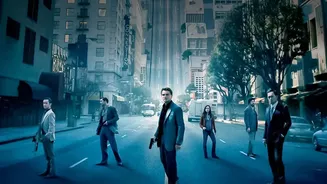
Christopher Nolan's masterpiece is the ultimate puzzle box movie. The premise is simple: a team of specialists enters people's dreams to steal information. But the execution is anything but. With its 'dream within a dream' structure, the film builds a complex,
layered reality where the rules of physics are merely suggestions. Each level of the subconscious has its own timeline, creating a narrative that folds in on itself like a piece of intricate origami. The special effects aren't just for show; they are integral to the storytelling. Hallways that rotate, cities that fold onto themselves, and infinite staircases visually represent the instability of the dream world. It’s a film that demands your full attention, rewarding you with a story that is both an action-packed heist and a profound exploration of memory, grief, and reality itself. The final, ambiguous shot remains one of modern cinema's most debated endings.
Arrival (2016): The Linguistic Conundrum
What if first contact wasn't about war, but about language? Denis Villeneuve's 'Arrival' is a quiet, cerebral film that finds its central puzzle in communication. When twelve mysterious alien pods appear across the globe, linguist Louise Banks is tasked with deciphering their complex, circular language. The film avoids sci-fi clichés of explosive battles, instead focusing on the painstaking, fascinating process of two species trying to understand one another. The narrative itself is a puzzle, mirroring the non-linear nature of the aliens' language. Revelations unfold not through action, but through Louise's growing understanding, leading to a stunning twist that re-contextualizes the entire film. The special effects are subtle but powerful, from the breathtaking design of the alien 'Heptapods' to their ink-blot-like written language. 'Arrival' is a story about how language shapes our perception of time and reality, making it one of the most intelligent and emotionally resonant sci-fi films ever made.
2001: A Space Odyssey (1968): The Cosmic Riddle
Stanley Kubrick’s '2001' is less a story and more a cinematic koan. It's the grandfather of cosmic mystery, a film that boldly presents questions about evolution, artificial intelligence, and humanity's place in the universe without offering any easy answers. From the iconic opening scene of apes discovering the first tool to the psychedelic journey 'beyond the infinite,' the film is a masterclass in visual storytelling. The narrative is sparse, trusting the audience to connect the dots between prehistoric dawn, a near-future space mission, and a baffling, abstract conclusion. The film's villain, the eerily calm AI HAL 9000, provides the central conflict, raising still-relevant questions about the dangers of technology. The special effects, revolutionary for their time, still hold up today, creating a sense of weightlessness and awe that few films have matched. It is a true cinematic experience that operates on a philosophical and sensory level.
Interstellar (2014): The Gravitational Epic
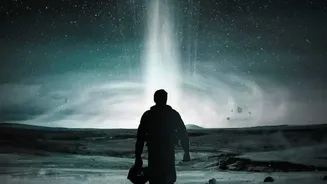
Another Christopher Nolan epic, 'Interstellar' trades the subconscious for the cosmos. Facing a dying Earth, a group of astronauts travels through a wormhole in search of a new home for humanity. The film’s narrative puzzle is rooted in theoretical physics, particularly Einstein's theory of relativity. Time dilation becomes a gut-wrenching dramatic device, where hours spent on one planet equal decades back on Earth. This creates an immense emotional core, as the protagonist races against time not just for humanity, but to see his children again. The special effects are spectacular, bringing black holes, gargantuan waves on distant planets, and the multi-dimensional tesseract to life with scientific accuracy. 'Interstellar' combines the high-stakes adventure of a space opera with the mind-bending concepts of hard science fiction, grounding its cosmic mystery in the powerful, relatable theme of love.
Blade Runner 2049 (2017): The Existential Mystery
Denis Villeneuve returns to sci-fi with a sequel that arguably surpasses the iconic original. 'Blade Runner 2049' is a neo-noir detective story set in a visually breathtaking, dystopian future. The central mystery seems straightforward: a new model of Blade Runner, K, uncovers a secret that could plunge society into chaos. But the puzzle is less about the plot and more about identity. As K digs deeper, the line between human and artificial becomes increasingly blurred, forcing both him and the audience to question what it truly means to be human. The film is a visual feast, with Oscar-winning cinematography and special effects that create a world that is both beautiful and bleak. Every frame is meticulously composed, from the smog-choked streets of Los Angeles to the eerie orange haze of a desolate Las Vegas. It’s a slow-burn, philosophical journey that delivers a cosmic mystery of the soul.