



The Sun's 11-Year Heartbeat
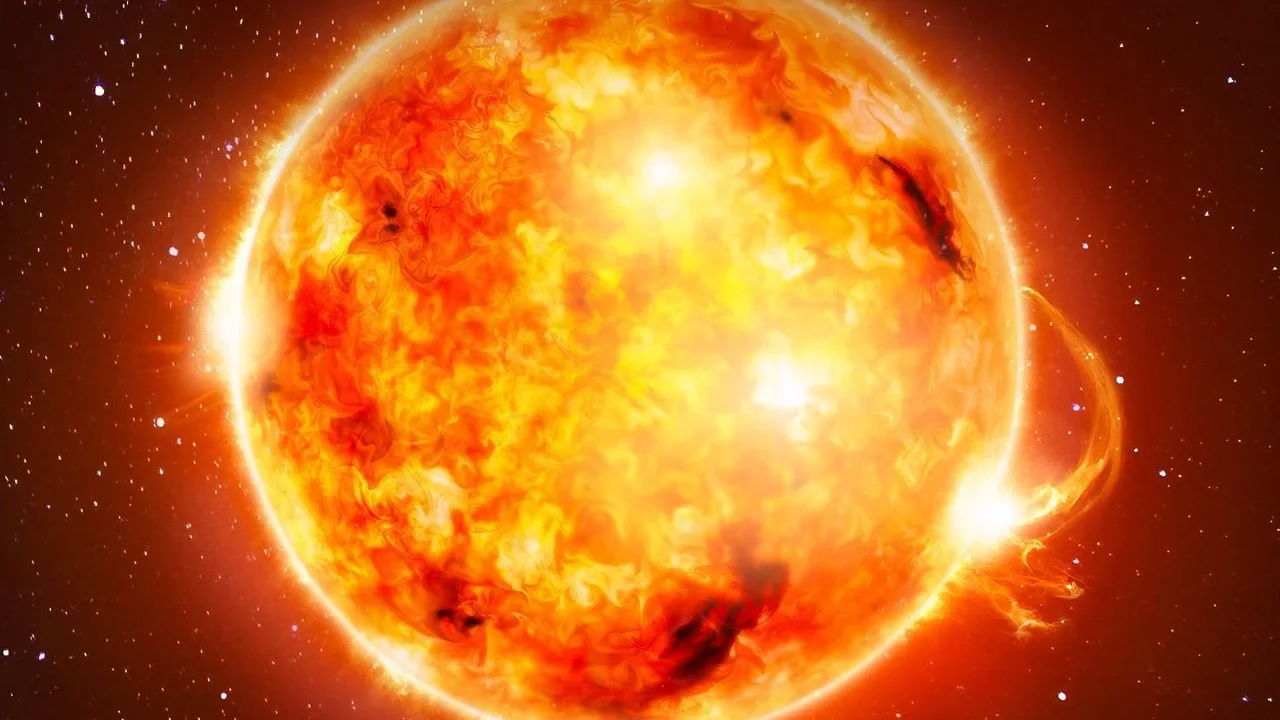
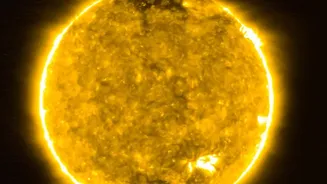
The sun operates on a roughly 11-year cycle, swinging between periods of calm and storm. The quiet phase is known as the solar minimum, while the peak of activity is called the solar maximum. We are currently in Solar Cycle 25, which began in December
2019 and has proven to be more active than originally predicted. During solar maximum, the sun's magnetic field becomes tangled and chaotic. This magnetic turmoil leads to a dramatic increase in sunspots—cooler, darker patches on the solar surface that are hotspots of intense magnetic activity. These sunspots are the breeding grounds for the two phenomena that directly impact Earth: solar flares and coronal mass ejections (CMEs).
Cosmic Blasts: Flares and CMEs
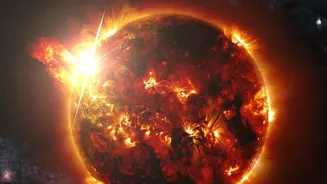
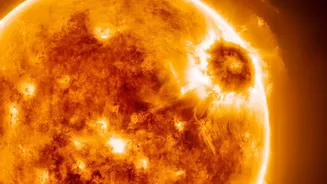
Think of solar flares as giant explosions on the sun's surface. They release immense bursts of energy, primarily in the form of X-rays and ultraviolet radiation, that travel at the speed of light. If a flare is aimed at Earth, this radiation can reach us in just eight minutes. Coronal Mass Ejections, or CMEs, are even more dramatic. They are enormous clouds of magnetised plasma and charged particles hurled from the sun's outer atmosphere (the corona) into space. A CME travels more slowly than a flare's radiation, taking anywhere from 15 hours to several days to cross the 150 million kilometres to Earth. It's these two types of solar outbursts, which happen far more frequently during solar maximum, that are responsible for a fascinating duality of effects.
Painting the Sky: How Auroras Get Brighter
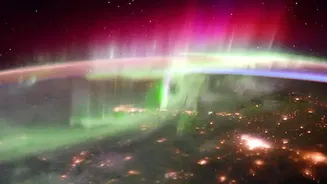
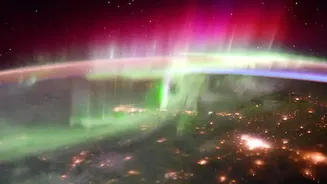
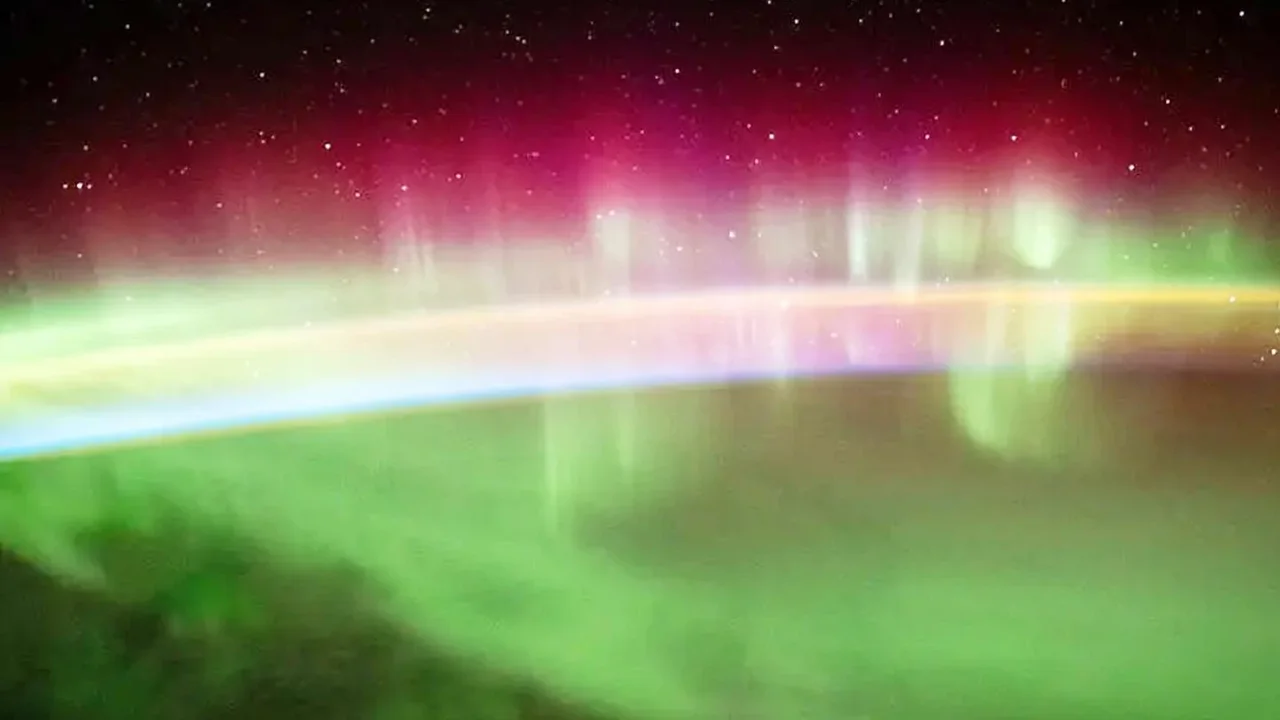
The stunning beauty of the aurora borealis (northern lights) and aurora australis (southern lights) is a direct result of CMEs. When the cloud of charged particles from a CME slams into Earth's magnetosphere—our planet's protective magnetic shield—it transfers a massive amount of energy. This interaction funnels the energetic particles along magnetic field lines towards the North and South Poles. As these particles rain down into our upper atmosphere, they collide with atoms of oxygen and nitrogen. This collision excites the atmospheric gases, causing them to glow in a brilliant display of colours, most commonly green (from oxygen) and sometimes red, pink, or purple. During solar maximum, the increased frequency and intensity of CMEs send more particles our way, resulting in auroras that are brighter, more frequent, and visible from lower latitudes than usual.
Jamming the Airwaves: Radio Disruption Explained
While CMEs paint the sky, the radiation from solar flares has a more disruptive effect on our technology, particularly high-frequency (HF) radio communications. HF radio, used by aviators, mariners, and amateur radio operators for long-distance communication, relies on a layer of Earth's upper atmosphere called the ionosphere. Signals in the 3-30 MHz band are bounced off the ionosphere to travel over the horizon. However, the intense X-ray radiation from a solar flare supercharges the lowest part of the ionosphere, known as the D-layer. This causes it to become highly absorbent to HF radio waves instead of reflecting them. The result is a radio blackout on the sunlit side of the Earth, which can last for minutes to hours, silencing crucial communication channels. CMEs can also contribute to radio issues by causing geomagnetic storms that disturb the ionosphere.