





The Legend of the Seven Pagodas
The coastal town of Mahabalipuram in Tamil Nadu, a UNESCO World Heritage site, is famous for its intricate rock-cut temples and the magnificent Shore Temple. Built during the Pallava dynasty, it stands as a testament to 8th-century architectural genius.
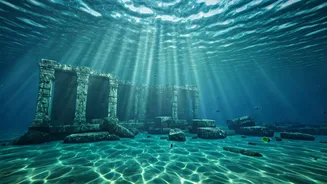
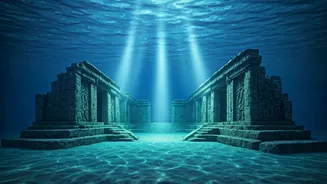
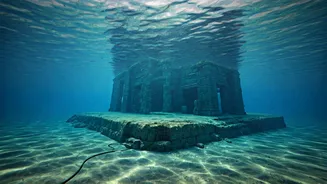
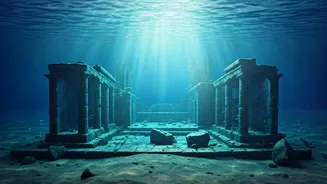
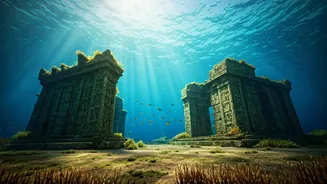
But local folklore and accounts from early European sailors speak of a grander complex. The legend of the 'Seven Pagodas' suggests the Shore Temple was not alone, but one of seven such structures, six of which were claimed by the ocean. For generations, it was a story passed down, a piece of romantic history whispered by fishermen who sometimes claimed to glimpse glittering structures beneath the waves. The 2004 Indian Ocean tsunami gave the legend a startling dose of reality when the receding waters briefly exposed long rows of stone structures never seen before, reigniting scientific and popular interest.
Peering Through the Murky Depths
Exploring the seabed off a busy coast is not simple. The water is often murky, and currents can be strong. This is where modern technology comes in, acting as the eyes for archaeologists where human vision fails. The key tool in the hunt for Mahabalipuram's lost heritage is sonar. Instead of light, sonar uses sound to 'see' underwater. The Archaeological Survey of India (ASI), in collaboration with institutions like the National Institute of Ocean Technology (NIOT) and the Indian Navy, began using sonar to systematically map the seafloor off the Mahabalipuram coast. These efforts turn the challenging underwater environment into a landscape that can be studied and understood.
How Sonar Paints a Picture
The primary technology used is side-scan sonar. Imagine a device, often towed behind a boat, that sends out fan-shaped pulses of sound to either side. These sound waves travel to the seafloor, bounce off whatever is there, and return to the device. Hard objects, like rock or man-made walls, produce a strong echo, while soft surfaces like sand and silt create a weaker one. A computer then translates these returning echoes into a detailed, almost photographic black-and-white image of the seabed. This allows researchers to cover large areas quickly, identifying shapes and textures that don't look natural. Anomalies—like straight lines, right angles, or clusters of large blocks—immediately stand out from the surrounding sand and warrant a closer look.
What Has Been Found?
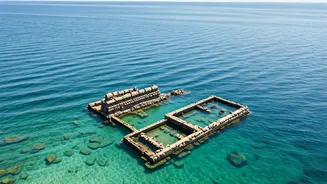
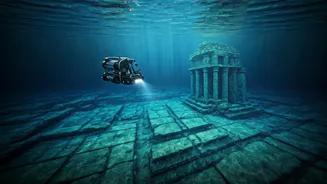
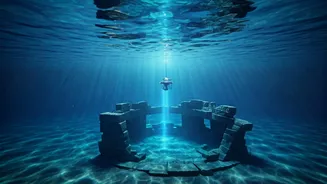
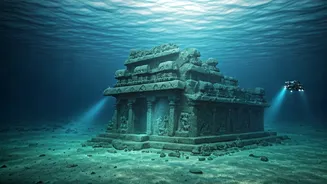
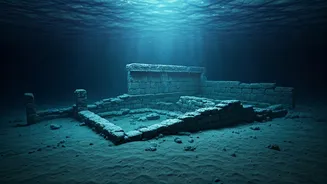
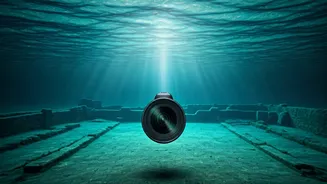
The sonar surveys, which began in earnest after the 2004 tsunami, have yielded significant results. Early explorations identified what appeared to be a 70-meter-long wall and the remains of other submerged temples within 500 meters of the shore. Subsequent investigations by the ASI's Underwater Archaeology Wing (UAW) and NIOT have confirmed the presence of man-made structures. They have documented submerged walls, scattered dressed stone blocks, platforms, and even steps leading to what might have been a larger complex. Some of these ruins are located between 5 to 8 meters deep. In August 2025, the UAW resumed its studies, now equipped with advanced tools like a Remotely Operated Vehicle (ROV) that can capture high-resolution video without disturbing the site. These findings strongly indicate that a significant, large-scale construction once existed where there is now only ocean.
Connecting Myth to History
While these findings don't perfectly map onto the legend of exactly six submerged temples, they provide powerful evidence that Mahabalipuram was once much larger than what is visible on land today. Archaeologists believe these submerged structures were part of the ancient port city, which was a bustling hub of maritime trade during the Pallava era and possibly even earlier. Radiocarbon dating of materials found on the submerged structures suggests different periods of submergence, with some evidence pointing to events as early as the 1st century and others to a possible tsunami in the 13th century. The work is painstaking. Divers must follow up on the sonar targets, and even then, structures are often covered in thick marine growth, making them difficult to identify precisely. Each wall and stone block is a piece of a puzzle, slowly helping historians and archaeologists reconstruct the story of this lost part of a great city.