








The Problem on the Ground
The engine of the AI revolution is the data centre, but its environmental cost is staggering. These server-packed warehouses consume nation-sized amounts of electricity and water. By 2030, global data centres could use nearly a trillion terawatt-hours
of electricity annually. In places like Northern Virginia, the world's largest data centre market, the electrical grid is already so strained that new permits have been halted. It's not just about power; it's about water for cooling and vast tracts of land. According to a UN University report, by the end of the decade, AI's water consumption could equal the annual domestic needs of 1.3 billion people. This immense footprint is forcing the industry to consider a solution that was once pure science fiction.
The Solution in the Sky
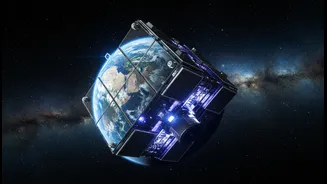
Space offers an elegant, if ambitious, answer to Earth's biggest data centre problems. In low-Earth orbit, solar panels can harvest sunlight continuously, without interference from weather or the day-night cycle, generating significantly more power than their terrestrial counterparts. The second major advantage is cooling. Space is a near-perfect vacuum, close to absolute zero. This allows for passive cooling systems that radiate heat away at zero operating cost, a stark contrast to the water-intensive cooling required on Earth. By moving compute infrastructure into orbit, companies hope to access unlimited power and free cooling, bypassing earthly constraints on land, water, and energy grids.
Who is Building This Future?
The race to orbit is on, attracting both tech giants and ambitious startups. Companies like SpaceX and Blue Origin are leveraging their launch capabilities to plan massive orbital data centre constellations. Google is also in the running with 'Project Suncatcher', aiming to launch prototype satellites by early 2027. A host of startups are also making significant headway. Starcloud, a Washington-based company, has already successfully run an NVIDIA H100 GPU in orbit. Others, like Lonestar Data Holdings, OrbitsEdge, and Aetherflux, are developing everything from hardened orbital computers to entire data storage services on the Moon. In India, a partnership between Sarvam AI and Pixxel aims to develop an orbital data centre to process AI workloads in space.
The Hurdles Are Still Astronomical
Despite the promise, sending data centres into space is not a simple lift-and-shift operation. The engineering challenges are immense, from protecting sensitive electronics against cosmic radiation to managing heat and avoiding collisions with space debris. Launch costs remain the biggest economic barrier. Experts estimate that for orbital computing to be cost-competitive with facilities on Earth, the price of launching a kilogram into orbit needs to fall to around $200, a steep drop from today's prices of over $2,500. Then there's the issue of latency. Transmitting data to and from space takes time, which could make orbital centres unsuitable for real-time applications like financial trading. Finally, there are maintenance and regulatory hurdles to clear before this vision can become a commercial reality.