


For decades, we’ve understood the universe to be about 13.8 billion years old. Now, a provocative new theory from the University of Ottawa doubles that figure to 26.7 billion, forcing us to question everything we thought we knew.
The Universe We Thought We Knew
The long-accepted age
of our universe is 13.8 billion years. This figure is a cornerstone of the standard cosmological model, known as Lambda-CDM. It’s a powerful theory that explains many of our key observations about the cosmos, from the faint afterglow of the Big Bang, called the Cosmic Microwave Background, to the large-scale structure of galaxies. The model assumes that the universe began with the Big Bang and has been expanding and cooling ever since. It also relies on two mysterious ingredients: dark energy, a force causing the expansion to accelerate, and dark matter, an invisible substance providing the extra gravitational pull needed to hold galaxies together. Together, these are thought to make up 95% of the cosmos.
A Radical New Timeline
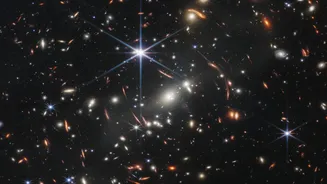
A new study by Rajendra Gupta, a physics professor at the University of Ottawa, suggests a dramatically different timeline. He proposes the universe is actually 26.7 billion years old, almost double the standard estimate. This idea emerged from trying to solve the 'impossible early galaxy problem'. Recent observations from the James Webb Space Telescope (JWST) have revealed galaxies in the very distant, early universe that appear surprisingly massive and mature. According to the 13.8-billion-year model, there simply wasn't enough time for such large galaxies to form. By stretching the universe’s age, Gupta's model provides billions of extra years for these galaxies to develop.
Resurrecting Old Theories
Gupta's model, called CCC+TL, achieves this by combining the expanding universe with two other ideas, one of which has long been on the fringes of physics. The 'TL' stands for 'Tired Light', a concept first proposed by Fritz Zwicky in 1929. It suggests that light loses energy as it travels over vast cosmic distances, making distant objects appear redder—a phenomenon known as redshift—independent of expansion. The 'CCC' part stands for 'Covarying Coupling Constants', which proposes that fundamental physical constants (the rules that govern forces like gravity) might not be constant at all, but could change over time. This hybrid approach reinterprets the redshift data that underpins our age calculations.
A Cosmos Without Dark Matter?
One of the most striking consequences of the CCC+TL model is that it may eliminate the need for dark matter and dark energy. In Gupta's framework, the effects we attribute to these invisible components could instead be explained by the shifting physical constants and the tired light phenomenon. For example, the model was able to explain the observed rotation of 175 galaxies without invoking dark matter, a major departure from the standard model. While the Lambda-CDM model has been incredibly successful, the fact that dark matter and dark energy have never been directly detected remains one of its biggest challenges. This new theory offers a potential, if controversial, way out.
What Happens Now?
It is crucial to understand that this new proposal is not yet a replacement for the standard cosmological model. It is a single theory that now faces the long process of scientific scrutiny. Other physicists will test its assumptions, check its math, and see if it holds up to other observations where the standard model has proven successful. For example, the 'tired light' theory was largely dismissed decades ago because it failed to explain key observations, like the time dilation of distant supernovae and the precise blackbody spectrum of the Cosmic Microwave Background. Gupta's hybrid model will need to prove it can overcome these historical hurdles. Ultimately, future observations, particularly from the JWST, may help distinguish between the competing explanations and determine if our cosmic story needs a new beginning.