


A Faint Speck Opens a New Chapter
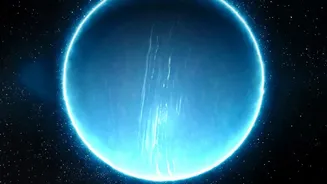
In early 2025, astronomers using the James Webb Space Telescope (JWST) spotted a faint object in a series of long-exposure images of Uranus. This tiny dot, provisionally named S/2025 U 1, was confirmed as the 29th known moon of the planet. Estimated to
be just 10 kilometres in diameter, it's one of the smallest moons ever found in the Uranian system. Its minuscule size and faintness are why it remained hidden for so long, evading even the Voyager 2 spacecraft which flew past the planet in 1986. The discovery was made by a team from the Southwest Research Institute, who identified the moon orbiting about 56,000 kilometres from the planet's centre, nestled between the orbits of two other small moons, Bianca and Ophelia.
Uranus: The Tilted, Crowded Giant
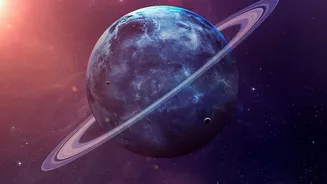
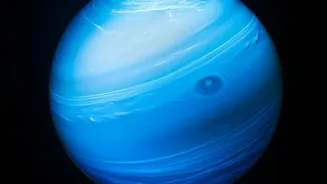
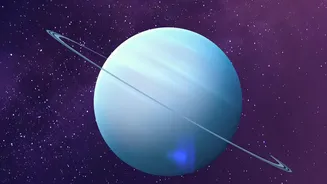
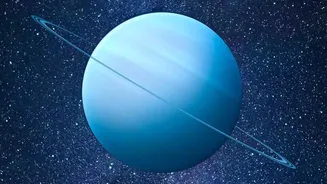
Understanding why another small moon matters requires appreciating how strange Uranus is. Known as the “sideways planet,” it is tilted at a staggering 98-degree angle, meaning it essentially orbits the sun on its side. Scientists believe this extreme tilt is the result of a cataclysmic collision with an Earth-sized object billions of years ago. This ancient impact would have created a massive debris disc around the planet's new, tilted equator. It is from this disc that its inner moons are thought to have formed. This makes them invaluable fossils of that violent event. The inner moon system of Uranus is also the most crowded one known in our solar system. The moons orbit so closely together that computer simulations suggest their gravitational interactions are chaotic, possibly leading to collisions over millions of years.
Clues from a Small Survivor
The existence of S/2025 U 1 provides a crucial new data point for understanding this complex system. Its nearly circular orbit suggests it is a 'regular' moon, meaning it formed in place from that primordial debris disk rather than being a captured object from elsewhere. Each new regular moon helps scientists refine their models of the ancient collision, offering clues about the size and composition of the impactor that forever changed Uranus. Furthermore, finding this moon in a seemingly stable orbit challenges existing models of the system's chaotic dynamics. It raises the question of whether there are more, even smaller moons yet to be found, and how they all manage to coexist in such a tightly packed neighbourhood without crashing into each other.
Shepherding the Rings
Many of Uranus's inner moons also play a critical role as 'shepherd moons'. Uranus has a system of 13 known rings that are remarkably thin and dark. Left to their own devices, the particles in these rings would naturally spread out and dissipate. Shepherd moons orbit near the rings, using their gravitational pull to keep the ring particles confined, essentially 'herding' them like cosmic sheep. The two innermost moons, Cordelia and Ophelia, are known to shepherd Uranus's brightest ring. The discovery of a new moon within this complex region provides another piece of the puzzle, helping scientists understand the delicate gravitational dance that maintains this intricate ring and moon system. Its presence could help explain the structure of nearby faint rings or dust bands that were previously unaccounted for.
From Our Solar System to Beyond
Studying the formation and evolution of moons in our own solar system provides an essential baseline for understanding planetary systems everywhere. Each moon, no matter how small, is a time capsule containing information about the history of its parent planet. The processes that shaped the moons of Uranus—massive impacts, debris disk formation, and gravitational sculpting—are thought to be common throughout the universe. By piecing together the story of this distant, icy system, scientists gain insights that help them interpret data from exoplanets orbiting other stars. The discovery of S/2025 U 1, made possible by the advanced capabilities of the JWST, demonstrates that even our own cosmic backyard still holds profound surprises.