







A New Standard in Space
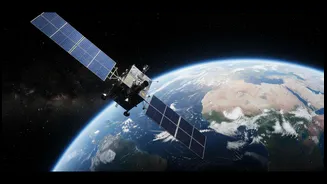
Mounted on the International Space Station, NASA's CLARREO Pathfinder (CPF) is not just another camera pointed at Earth. It is a highly specialized spectrometer designed to measure a crucial climate variable: the amount of sunlight reflected by our planet.
This reflected solar radiation, influenced by clouds, oceans, land, and ice, is a key component of Earth's energy budget, the balance between incoming and outgoing energy that ultimately governs our climate. What makes the CPF revolutionary is its accuracy. It is designed to be five to ten times more precise than any existing sensor of its kind, with its measurements directly traceable to international scientific standards. This remarkable precision means scientists can detect subtle climate trends much sooner, potentially shortening the time it takes to confirm long-term changes from decades to years. Recently achieving 'first light' in the summer of 2026, the instrument has already demonstrated its ability to capture detailed data, marking a major milestone for the mission.
The Team Captain, Not the Whole Team
The primary role of the CLARREO Pathfinder isn't to see everything, but to be an impeccable on-orbit reference. Think of it as a tuning fork for other instruments. Its main job is to serve as a calibration standard for other Earth-observing satellites. Over time, sensors in the harsh environment of space can degrade, and their measurements can drift. By cross-calibrating with the Pathfinder's ultra-accurate data, the measurements from other satellites, such as the CERES and VIIRS instruments, can be corrected and made more reliable. This act of 'inter-calibration' improves the quality and consistency of the entire fleet of climate-monitoring assets, both governmental and commercial. It elevates the data from the whole network, ensuring that observations made by different instruments in different years can be confidently compared. This creates a more robust and trustworthy long-term climate data record.
The Global Observing Network
The CLARREO Pathfinder operates as one part of a much larger, globally coordinated effort. The Global Climate Observing System (GCOS), established in 1992, is a network of networks, comprising thousands of instruments on satellites, in the ocean, and on land. This system monitors what are known as Essential Climate Variables (ECVs) — critical indicators of Earth's climate, from surface temperature and sea-level rise to atmospheric chemistry. The GCOS combines data from satellites, weather balloons, ocean buoys, and ground stations to provide a comprehensive picture of the entire planet. No single instrument, no matter how powerful, can capture this sheer breadth of information. Some sensors specialize in ocean temperatures, others in polar ice thickness, and still others track greenhouse gases in the atmosphere. It is the integration of all these different data streams that allows scientists to build and validate complex climate models.
Why One Can't Replace the Many
The limitation of the CLARREO Pathfinder is therefore not a flaw, but a function of its design and purpose. Its incredible accuracy comes with a trade-off in coverage. While other satellites are designed for broad, continuous global mapping, the Pathfinder provides benchmark-quality data in specific locations and times. Its power lies in its depth, not its breadth. Furthermore, climate is a multifaceted system. Measuring reflected sunlight is vital, but it is only one piece of the puzzle. The wider climate network measures dozens of other variables that CPF is not designed to see, such as ocean salinity, forest biomass, or the chemical composition of the stratosphere. Replacing this diverse, planet-spanning network with a single instrument would be like trying to understand a full orchestra by only listening to the lead violin. The true strength of modern climate science lies in synergy—combining the pinpoint accuracy of reference instruments like the Pathfinder with the global coverage of the wider observing system.