

A New Era of Celestial Sight
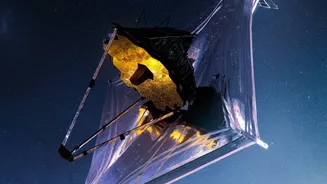
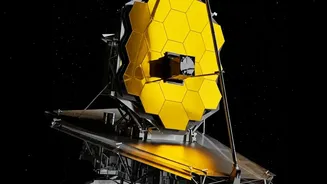
Before the James Webb Space Telescope, studying the atmospheres of small, rocky planets was largely theoretical. While we could detect these worlds, figuring out if they had an atmosphere—let alone what it was made of—was beyond our reach. JWST changed
the game. It is designed to see the universe in infrared light, which is invisible to the human eye but perfect for atmospheric science. When a planet passes in front of its star, a tiny fraction of starlight filters through its atmosphere. The gases present absorb specific wavelengths of this light, leaving a unique chemical fingerprint that Webb's sensitive spectrographs can read. This technique, called transmission spectroscopy, allows astronomers to identify molecules like water, carbon dioxide, and methane from light-years away.
First Look at Lava Worlds
Some of the most dramatic early results have come from ultra-hot 'super-Earths'—rocky planets larger than our own, orbiting perilously close to their stars. One such world, 55 Cancri e, is a planet so hot its surface is likely a molten magma ocean. Scientists long debated whether such a world could even hold onto an atmosphere. In 2024, JWST delivered the best evidence to date that it does. The data suggests an atmosphere rich in gases like carbon monoxide, likely bubbling out from the magma ocean below in a process called 'outgassing'. This finding on 55 Cancri e, and similar observations of another lava world, TOI-561 b, challenge the theory that planets so close to their stars would have their atmospheres completely stripped away. These are not habitable worlds, but they provide a crucial natural laboratory for understanding how planetary atmospheres form and survive in extreme environments.
The Significance of Finding Nothing
Just as important as finding an atmosphere is confirming its absence. The TRAPPIST-1 system, located 40 light-years away, hosts seven Earth-sized rocky planets, several of which are in the 'habitable zone' where liquid water could exist. This made it a top target for Webb. However, observations of the innermost planets, TRAPPIST-1b and 1c, revealed they are likely bare, airless rocks. More recently, studies of TRAPPIST-1d, which is on the edge of the habitable zone, also failed to detect an Earth-like atmosphere. This doesn't mean the planet is a bare rock—it could have a very thin atmosphere or one obscured by high-altitude clouds—but it rules out a thick, easily detectable one. These findings are sobering but vital; they show how difficult it can be for planets orbiting volatile red dwarf stars to retain their atmospheres, a key factor in the search for life.
The Complication of Starlight
One of the major challenges emerging from Webb's data is distinguishing between a planet's atmosphere and the star it orbits. This was highlighted by observations of GJ 486 b, another rocky super-Earth. Initial data showed a tantalizing hint of water vapour. However, follow-up observations suggested this signal might not be from the planet at all. Instead, it could be an illusion created by cool, dark 'starspots' on the surface of the host star. As the planet transits, it blocks different parts of the star's surface, and if it crosses over a cooler spot, it can create a spectral signal that mimics water. Later thermal emission data from the planet's hot dayside was more consistent with a bare rock, making the starspot theory the more likely explanation. This demonstrates the incredible complexity of this new science and the need for multiple observation methods to confirm any findings.
The Hunt for Signs of Life
Ultimately, a primary goal of this research is to find biosignatures—gases like oxygen and methane that, in combination, could indicate the presence of life. We are not there yet. The first wave of JWST data is focused on foundational questions: Can these rocky worlds even have atmospheres? What are they like? The results show a complex reality. Some hot planets unexpectedly have thick atmospheres, while some potentially temperate ones appear to have none. The work is painstaking, and confirming any single biosignature will require immense amounts of data and ruling out all non-biological explanations. The telescope's findings on planets like K2-18 b, a candidate 'Hycean' (hydrogen-rich ocean) world, have detected methane and carbon dioxide, but the path to confirming habitability is a long one. Still, every observation adds a crucial piece to the puzzle.