






You'd Be Stretched Like Spaghetti
One of the most bizarre yet aptly named concepts in astrophysics is 'spaghettification'. [2, 3] Popularised by Stephen Hawking, it describes what would happen if you fell into a black hole feet-first. [5] The gravitational pull on your feet would be so
much stronger than on your head that your body would be stretched vertically and compressed horizontally, like a noodle. [2, 5] This isn't just a quirky thought experiment; astronomers have observed distant stars being torn apart and stretched into streams of gas by this exact process, known as a tidal disruption event.
They Bend Time Itself
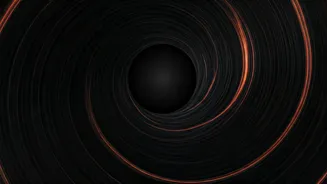
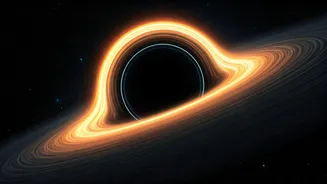
According to Einstein's theory of general relativity, massive objects warp the fabric of spacetime, and black holes are the ultimate expression of this. [6, 21] This warping effect means that time actually passes slower closer to a black hole. [6, 20] An observer watching you approach a black hole would see your movements slow down until you appear to freeze completely at the edge, an area called the event horizon. [6, 21] For you, however, time would feel perfectly normal as you cross this point of no return. [6, 12] This effect, called gravitational time dilation, happens everywhere, even on Earth, but it's incredibly extreme near a black hole. [20, 29]
They're Not Actually Black
While nothing can escape from inside a black hole's event horizon, Stephen Hawking theorised that black holes aren't completely black. [1, 7] Due to weird quantum effects happening right at the edge, they are predicted to slowly emit a faint glow of particles, now known as Hawking radiation. [1, 15, 18] This process involves pairs of 'virtual particles' that pop into existence from empty space. [7] If this happens at the event horizon, one particle can fall in while the other escapes, carrying away a tiny bit of the black hole's energy. [7, 18]
They Eventually Evaporate
Because they release Hawking radiation, black holes are expected to very slowly lose mass and energy over immense timescales. [1, 19] This means that even the most massive black holes will eventually shrink and completely 'evaporate' in a final burst of energy. [1, 11] Don't hold your breath, though. For a black hole with the mass of our Sun, this process would take longer than the current age of the universe by many orders of magnitude. [7] In fact, for stellar-mass black holes to even begin evaporating, they must be colder than the surrounding universe, so they are currently absorbing more energy than they emit. [1, 15]
They Come in All Sizes
Black holes aren't a one-size-fits-all phenomenon. The most common type, stellar-mass black holes, are formed from the collapse of a single massive star and can be up to 20 times more massive than our Sun. [23] Then there are the supermassive black holes, which are millions or even billions of times the mass of the Sun and are believed to exist at the centre of most large galaxies, including our own Milky Way. [3, 8, 22] Scientists are still working to understand how these giants form, but it's thought they grow by consuming stars, gas, and even other black holes. [13, 23]
They Create an Information Paradox
The discovery of Hawking radiation created a major puzzle for physicists called the 'information paradox'. [4, 17] A fundamental rule of quantum mechanics is that information can never truly be destroyed. [17, 25] However, since Hawking radiation appears to be random and thermal, it doesn't seem to contain any information about what fell into the black hole. [4, 28] If a black hole evaporates completely, what happens to the information of all the matter it consumed? [24, 25] This question remains one of the biggest unsolved problems in physics, challenging the very foundations of our understanding of the universe. [4]