


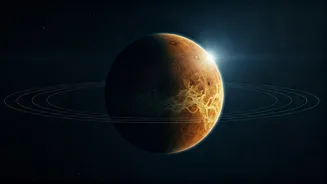


A Day Longer Than a Year
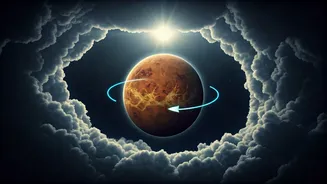
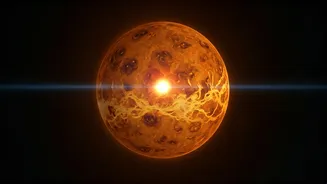
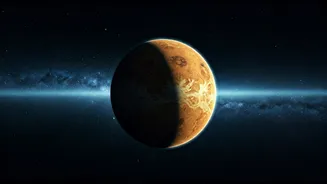
Let’s start with the bizarre basics. Most planets in our solar system, including Earth, spin on their axis in the same direction they orbit the sun—a counter-clockwise motion known as prograde rotation. Then there's Venus. It spins clockwise, or in retrograde.
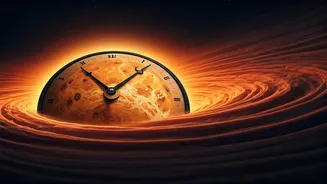
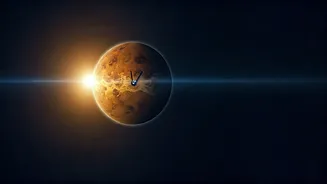
But that's not even the weirdest part. It does so with agonising slowness. A single rotation of Venus takes 243 Earth days to complete. In contrast, its journey around the sun, its year, takes only about 225 Earth days. This means a Venusian day is longer than a Venusian year, a fact that breaks our intuition about how planets should behave. It’s the only planet in the solar system with this strange characteristic, making it a true outlier.
The Paradox of Planetary Motion
So why is this a 'paradox'? It's all about how solar systems are born. When a star forms, it’s surrounded by a massive, rotating disk of gas and dust. As this material clumps together to form planets, it conserves its angular momentum. Think of an ice skater pulling their arms in to spin faster; the physics is the same. This process should result in all planets spinning in the same direction as the original disk and at a relatively brisk pace. Uranus is tilted on its side, and Venus spins backward slowly. While a giant impact is thought to have knocked Uranus over, the Venusian puzzle is more subtle. A single catastrophic impact would likely have left other tell-tale signs or required an impossibly precise collision. The slow, backward spin of Venus defies the simple story of planetary formation, forcing scientists to look for a more complex explanation.
The Atmosphere's Heavy Hand
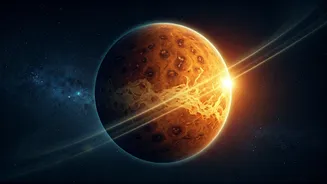
Calling it an 'atmosphere' is an understatement; it’s a thick, heavy blanket of carbon dioxide so dense that the pressure at the surface is over 90 times that of Earth's—equivalent to being nearly a kilometre deep in the ocean. This atmosphere is not just a passive layer of gas; it contains so much mass and energy that it's dynamically coupled to the solid planet itself. The winds on Venus whip around the planet at hurricane speeds, circling the globe in just four Earth days in a phenomenon known as 'super-rotation'. This colossal, moving mass of air exerts a significant frictional drag on the planet's surface, acting like a powerful brake.
A Tug-of-War in the Clouds
The most compelling theory suggests a delicate, long-term battle between gravity and the atmosphere. The sun’s immense gravity creates 'tides' in Venus’s body, just as the Moon creates ocean tides on Earth. These gravitational tides try to lock Venus into a tidally-locked state with the sun, similar to how our Moon always shows the same face to Earth. At the same time, intense solar radiation heats the dense atmosphere, creating powerful 'thermal tides'—waves of thickened, high-pressure air that travel around the planet. According to models, these atmospheric tides are so powerful they exert a torque on the planet's surface that works *against* its rotation. Over billions of years, this atmospheric drag could have been enough to first halt Venus's original, faster prograde spin and then slowly push it into its current, lazy retrograde motion. It's a cosmic tug-of-war that the atmosphere won.
Why Solving This Puzzle Matters
Understanding Venus isn't just about satisfying our curiosity about a strange neighbour. Venus is often called Earth’s twin because of its similar size and mass. It serves as a natural laboratory for what can happen to a terrestrial planet when its atmosphere runs wild. Did Venus once have a more Earth-like rotation and a more hospitable climate? By figuring out the forces that shaped its spin, scientists can refine their models of planetary evolution and climate. This, in turn, helps us understand the range of conditions that could support life on exoplanets far beyond our own solar system. Missions like NASA's upcoming VERITAS and DAVINCI+ aim to peer through the clouds, map the surface, and sample the atmosphere to finally confirm if this atmospheric tug-of-war is the real solution to the solar system's ultimate rotational paradox.