




More Than Just Pretty Pictures
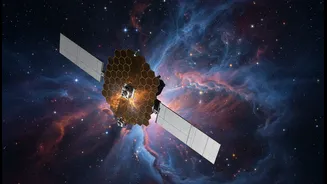
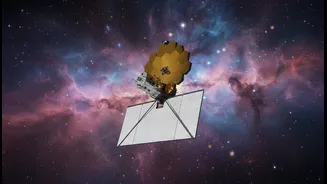
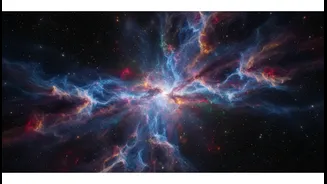
The breathtaking images released by NASA, the European Space Agency (ESA), and the Canadian Space Agency (CSA) are more than just cosmic art. Webb's true power lies in its ability to see the universe in infrared light, a spectrum largely invisible to the human
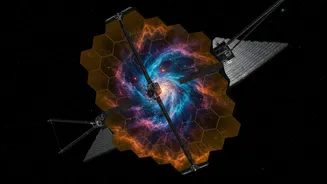
eye and even the Hubble Space Telescope. This allows it to pierce through dense clouds of cosmic dust that obscure the view of other telescopes, revealing the hidden processes of star birth and galaxy formation. While Hubble primarily sees in visible and ultraviolet light, Webb's massive 6.5-metre mirror and infrared instruments are designed to capture the faint light from the universe's most distant—and therefore oldest—galaxies. What we see as stunning nebulae and star clusters are actually rich datasets helping scientists understand the building blocks of the cosmos.
Decoding the Skies of Alien Worlds
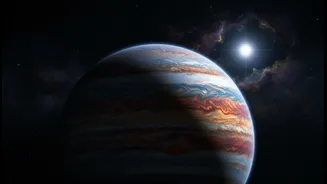
One of Webb's most revolutionary tasks is sniffing out the atmospheres of exoplanets—worlds orbiting other stars. Its spectrographs can analyze the starlight that passes through a planet's atmosphere, looking for the chemical fingerprints of different molecules. Recently, Webb has made remarkable findings, like detecting an atmosphere on a Jupiter-sized planet, WD 1856 b, which somehow survived the death of its star. This world, orbiting a dim white dwarf, was found to be bizarrely warm and possess an atmosphere with organic compounds, giving us a glimpse into the possible future of our own solar system. In another recent discovery, it found methane in the atmosphere of a temperate, Saturn-sized exoplanet, confirming theories about the composition of cooler gas giants. These findings are crucial steps in the ongoing search for habitable worlds beyond Earth.
Rewriting the History of the Early Universe
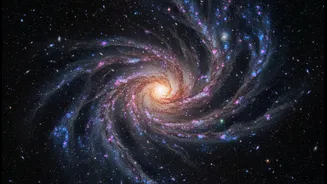
Webb was built to answer fundamental questions about our origins, and it's already delivering. By staring at patches of sky for hours, it creates 'deep fields' that reveal thousands of galaxies, some of which existed when the universe was less than a billion years old. These observations are challenging old models. Some of the earliest galaxies appear more mature and structured than previously thought possible. To celebrate its fourth year of operations in July 2026, the JWST team released an unprecedented image of Centaurus A, a peculiar galaxy shaped by a past collision. Webb’s infrared vision cut through the galaxy's thick dust lanes, resolving millions of individual stars and revealing the complex interplay between star formation and the galaxy's central supermassive black hole. This allows for a form of 'galactic archaeology,' where each star provides a clue to the galaxy's tumultuous history.
A New Era of Discovery
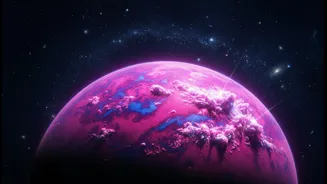
The telescope’s advanced instruments, like the Near-Infrared Camera (NIRCam) and the Mid-Infrared Instrument (MIRI), work in concert to provide a complete picture. NIRCam can spot individual stars, while MIRI excels at highlighting the glowing dust that signals new star birth. This dual capability gives astronomers an incredibly detailed view of the lifecycle of stars and galaxies. For instance, observations of the 'Roasted Planet' HD 80606 b revealed its atmosphere heats up and cools down much faster than models predicted, challenging our understanding of planetary physics. Similarly, by studying the famous 'Pink Planet,' Webb confirmed the presence of exotic salt clouds in the atmosphere of a cold world for the first time. Every new observation seems to bring both answers and a fresh set of fascinating questions, proving that the telescope's journey of discovery is just getting started.