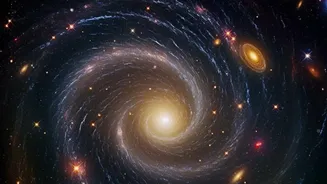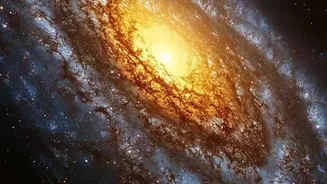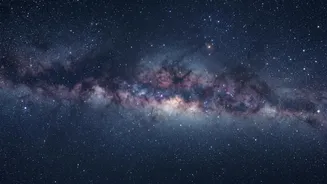



For decades, we’ve been told the universe is about 13.8 billion years old. But what if it’s twice that age? A provocative new model is forcing scientists to re-examine one of the most fundamental questions about our cosmic origins.
Our Current Cosmic Yardstick
The widely accepted
age of the universe, 13.8 billion years, isn’t just a guess; it's the cornerstone of the standard model of cosmology, known as the Lambda-CDM model. This model explains a vast range of observations, from the faint afterglow of the Big Bang, called the Cosmic Microwave Background (CMB), to the large-scale structure of galaxies. Scientists arrive at this age by measuring the current rate of the universe's expansion—the Hubble constant—and extrapolating backward to a single point of origin. The Lambda-CDM model incorporates dark energy (Lambda) and cold dark matter (CDM), mysterious components that together are thought to make up about 95% of the cosmos and dictate its evolution.
The 'Impossible' Galaxy Problem
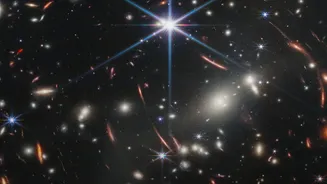
The Lambda-CDM model has been incredibly successful, but recent discoveries from the James Webb Space Telescope (JWST) have presented a significant puzzle. The powerful telescope has spotted galaxies in the distant, early universe that appear shockingly mature and massive. According to the standard 13.8-billion-year timeline, these galaxies, seen as they were just a few hundred million years after the Big Bang, shouldn't have had enough time to become so developed. This has been dubbed the 'impossible early galaxy problem,' prompting some scientists to question whether the standard model—and its timeline—is missing a key piece.
A Radical New Theory
Enter a new model from University of Ottawa physicist Rajendra Gupta. His theory, called CCC+TL, suggests the universe is actually 26.7 billion years old. This nearly doubles the amount of time available for those 'impossible' galaxies to form, making their advanced state entirely plausible. The theory is a hybrid, combining two ideas: Covarying Coupling Constants (CCC) and an old concept called 'Tired Light' (TL). The CCC part suggests that the fundamental forces of nature, which we assume are constant, might change over cosmic time. The 'tired light' part proposes an additional reason for why light from distant galaxies appears redshifted.
What Is 'Tired Light'?
In the standard model, the redshift of distant galaxies is explained by the expansion of space, which stretches light waves as they travel. The 'tired light' theory, first proposed by Fritz Zwicky in 1929, offers a supplementary explanation: that photons gradually lose energy on their long journey through the cosmos. While 'tired light' theories have been largely dismissed because they conflict with many observations, Gupta’s model doesn't replace cosmic expansion. Instead, he suggests that both phenomena happen at the same time, reinterpreting redshift as a hybrid effect. By combining this with evolving physical constants, the model can account for observations without needing dark matter or dark energy.
A Universe in Debate
While Gupta's 26.7-billion-year model offers an intriguing solution to the early galaxy problem, it remains a provocative but unproven idea. The vast majority of cosmological data still strongly supports the 13.8-billion-year age within the Lambda-CDM framework. Mainstream cosmology has repeatedly found that 'tired light' alone cannot explain key observations like the time dilation seen in distant supernovae. Gupta's model is one of several attempts to address growing 'tensions' in cosmology, such as disagreements in measuring the universe's expansion rate. For now, it represents a fascinating intellectual challenge to the standard story of our universe, highlighting that in science, even the biggest questions are never truly settled.