




Journey to the Centre of the Sun
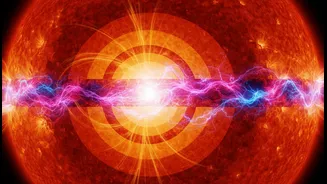
Our star may look like a uniform ball of fire, but its interior is a complex layer-cake of distinct zones. At the heart is the core, where nuclear fusion generates immense energy. This energy travels outward through the vast radiative zone, a calm region
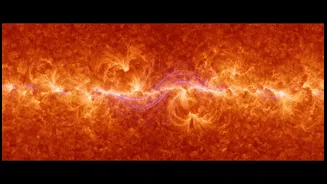
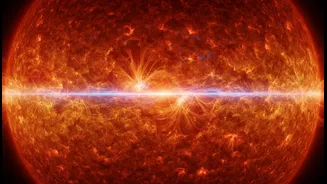
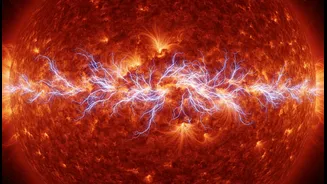
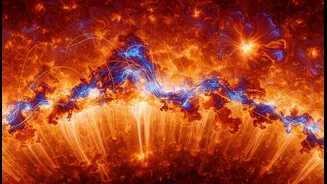
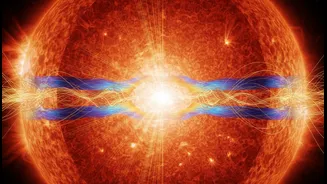
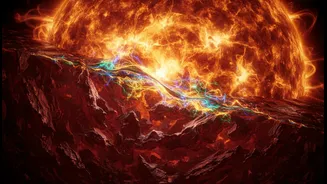
where energy is passed from particle to particle over millennia. The outermost 30% of the Sun is the convection zone, a roiling, boiling sea of hot plasma that carries heat to the surface. Sandwiched between the calm radiative zone and the chaotic convection zone is the tachocline. It is an incredibly thin layer, only about 4% of the solar radius, but it’s a place of extreme friction and change.
The Sun’s Great Divide
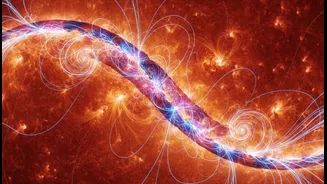
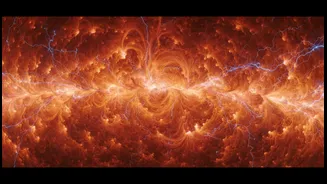
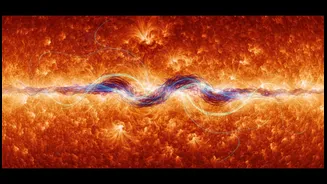
The tachocline is where two different styles of rotation meet, creating an enormous shear. The deep radiative zone rotates like a solid object, almost as if it were a spinning billiard ball. In contrast, the convection zone above it rotates differentially, meaning the equator spins much faster than the poles. This dramatic transition in speed happens across the narrow tachocline. For years, scientists have believed this intense shearing action is fundamental to the solar dynamo — the process that generates the Sun's powerful magnetic field. The tachocline is thought to stretch, twist, and amplify weak magnetic fields into the powerful ones that drive the entire solar cycle.
The Dynamo’s True Home
For a long time, the exact location of the solar dynamo was debated. Was it near the surface, or somewhere deeper? Recent helioseismic evidence—the study of the Sun's interior using wave oscillations, much like seismology on Earth—points decisively to a deep-seated origin. Studies have revealed patterns resembling the famous magnetic 'butterfly diagram' of sunspots, but located near the tachocline. This suggests that the magnetic activity we see on the surface, including sunspots that can trigger massive solar flares, has its roots right here in this deep, transitional layer. The tachocline appears to be the primary amplifier, the engine room where the magnetic fields responsible for space weather are forged.
A New Understanding of a Mysterious Layer
One of the biggest puzzles about the tachocline was its surprising thinness; early models couldn't explain why it didn't just spread out over time. Recent advanced computer simulations, some run on NASA's most powerful supercomputers, have provided a breakthrough. These models show that the very magnetic fields generated by the dynamo process actually help to confine the tachocline, keeping it thin and maintaining the sharp rotational shear. This self-regulating relationship is a major leap in our understanding. It confirms the tachocline as a critical component of the solar dynamo, not just a passive boundary.
Better Forecasts for Weather in Space
Understanding the tachocline isn't just an academic exercise. It has profound implications for our ability to forecast space weather. Severe space weather events, like coronal mass ejections (CMEs), can send billions of tons of charged particles hurtling towards Earth. These storms can disrupt our power grids, damage satellites, interfere with GPS and radio communications, and even pose a risk to astronauts. Currently, we can only see these events as they happen on the Sun's surface, giving us limited warning time. By understanding the deep origins of these magnetic fields in the tachocline, scientists hope to build better, longer-range predictive models. Evidence shows that rotational patterns originating near the tachocline can take years to reach the surface, a lag that could one day be the key to forecasting solar activity much further in advance.