


The Promise of Frozen Lunar Gold
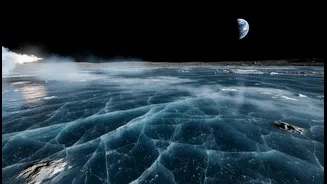
For decades, scientists theorized that water ice could exist in the permanently shadowed craters near the Moon's poles, where temperatures are colder than -170°C. In 2009, a NASA mission confirmed it, kicking off a new space race. This isn't just about
finding water; it's about unlocking the resources to live and work in space. This practice, called In-Situ Resource Utilization (ISRU), is a game-changer. Water ice can be melted for drinking or split into hydrogen and oxygen. Oxygen provides breathable air for habitats, while hydrogen and oxygen together create powerful rocket propellant. Tapping into these resources could dramatically reduce the cost and complexity of space exploration, as missions would no longer need to launch every drop of water and pound of fuel from Earth. This lunar water isn't just a resource; it's a historical archive. Trapped for potentially billions of years, the ice could contain clues about the formation of our solar system and the origin of life on Earth.
An Invisible, Globe-Spanning Threat
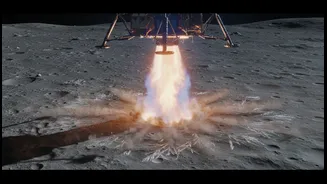
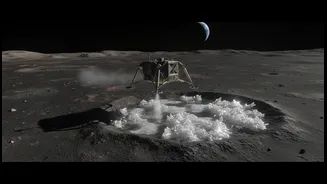
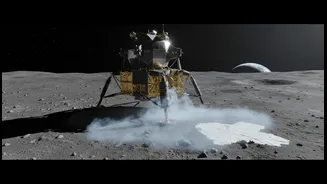
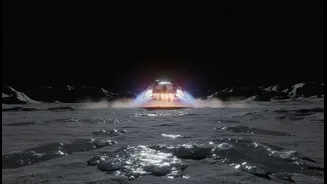
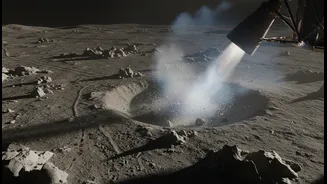
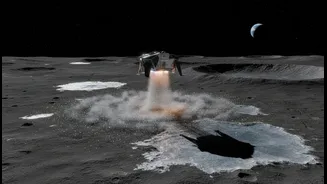
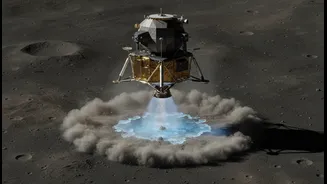
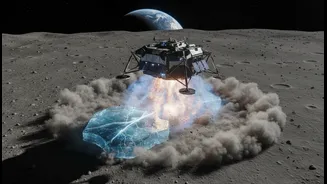
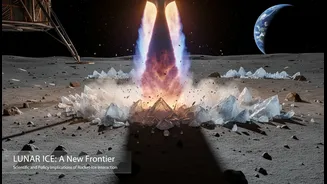
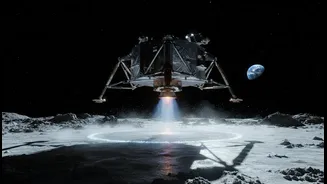
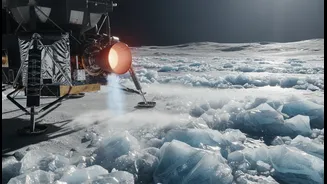
The very act of landing a spacecraft to access this ice poses a major threat to it. When a lander uses its engines for a soft touchdown, it blasts the lunar surface with hot exhaust gases, primarily composed of water and, in some engine types, methane. On Earth, our thick atmosphere would contain these gases. But the Moon has virtually no atmosphere. Computer simulations show that rocket exhaust expands rapidly in this vacuum, creating a temporary, globe-spanning atmosphere of its own. Molecules of water and methane from a single landing near the south pole can 'hop' ballistically across the entire lunar surface, reaching the north pole in a matter of days. Within months, a significant percentage of this exhaust freezes and settles in the same permanently shadowed craters that hold the pristine, ancient ice.
Lessons for Mission Planners
For the engineers and architects designing lunar missions, this contamination issue presents a complex challenge. The primary lesson is that landing sites must be chosen with extreme care. A lander touching down hundreds of miles away can still contaminate a key scientific site. This means mission planners must balance the need to land near valuable resources with the risk of corrupting them. Precision landing technology, once a 'nice-to-have', is now critical. Future landers will need to be able to target small, safe landing zones with pinpoint accuracy to minimize their impact. Furthermore, the size of the lander matters. A larger vehicle, like a SpaceX Starship, could deposit tons of water exhaust, potentially overwhelming the natural water signals scientists want to study. Engineers are now tasked with modeling, monitoring, and potentially mitigating the spread of exhaust as a routine part of mission planning. This could involve developing new engine technologies or choosing colder landing sites that might help trap contaminants locally.
Guidance for Policy Students and Lawmakers
The contamination problem extends beyond technical solutions into the realm of policy and international law. As more nations and private companies target the Moon's resource-rich poles, the risk of crowding and interference grows. The 1967 Outer Space Treaty forbids any nation from claiming sovereignty over lunar territory, but it is ambiguous on resource extraction. This has led to frameworks like the U.S.-led Artemis Accords, which propose 'safety zones' to prevent operational interference. The exhaust plume issue adds a new layer of complexity. Whose responsibility is it if one country's landing contaminates a site another country planned to study? This raises the need for international agreements on 'keep-out zones' around scientifically sensitive areas. These are not territorial claims, but protocols to protect finite scientific and historical assets, much like heritage sites on Earth. Without clear rules of the road, the race for lunar resources could lead to scientific loss and geopolitical friction.