



The Seven-Kilo Challenge
Most low-cost carriers in India limit cabin baggage to a total of seven kilograms. This isn't just about the main bag; it often includes your personal item, like a handbag or laptop case. This strict limit means that every single item you pack must justify
its weight. The goal is not just to stuff things in, but to create a versatile, lightweight travel system. Start by choosing the lightest possible bag—a soft-shell backpack or duffel often weighs less than a hard-shell trolley. Remember, the bag's own weight counts towards your limit, so a bag that weighs 2kg already uses up a significant portion of your allowance before you've even packed a single sock.
Fabric Is Everything: Think Smart, Not Bulky
The secret to packing for variable weather lies in your choice of fabrics. Bulky cotton jumpers and heavy jeans are your worst enemy. Cotton is heavy, holds moisture, and takes a long time to dry. Instead, focus on modern and natural performance fabrics. Merino wool is a travel superstar; it regulates body temperature, resists odour, and provides warmth without weight. A single merino wool base layer can keep you warm in the cold and remains breathable in milder temperatures. For other layers, look to synthetics like polyester and nylon blends, which are lightweight, moisture-wicking, and quick-drying. These are perfect for base t-shirts and mid-layers.
Master the Art of Layering
Instead of packing one thick, heavy jacket, think in terms of three distinct layers you can add or remove as the temperature changes. Your base layer should be a lightweight, moisture-wicking t-shirt or long-sleeve top. Your mid-layer provides insulation; this could be a light fleece or a cashmere sweater, which offers excellent warmth for its weight. Your outer layer should be a packable, water-resistant shell or a lightweight down-filled jacket that can compress into a tiny pouch. This three-part system is far more versatile than a single bulky coat and allows you to be comfortable in everything from a sun-drenched afternoon to a chilly, rainy evening.
Roll, Cube, and Conquer Your Space
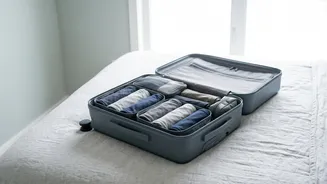
How you pack is as important as what you pack. The 'Ranger Roll' is a military technique that involves tightly rolling clothes and tucking in the ends to create a compact, secure bundle that won't unravel. This method saves significant space and can help minimise wrinkles in many fabrics. To take organisation to the next level, use packing cubes. These zippered fabric containers allow you to compartmentalise your bag. You can dedicate one cube to warm-weather clothes, another to cold-weather layers, and a third to undergarments. This not only compresses your clothing but also makes it easy to find what you need without unpacking your entire bag.
Build a Mix-and-Match Wardrobe
To maximise your outfits with minimal items, stick to a coordinated colour palette. Choose neutral base colours like black, grey, navy, or beige for your main items like trousers and jackets. Then, add one or two accent colours with your tops or accessories. This ensures that almost every item of clothing you pack can be worn with every other item, dramatically increasing your number of potential outfits. Think in terms of multi-purpose items: a pair of smart-looking trousers that are comfortable enough for a long journey, or a dress made from a wrinkle-resistant fabric that can be layered with a cardigan for a more formal look. Every piece should serve at least two functions.
Accessorise for Versatility
Accessories are a lightweight packer's best friend. A large scarf or a pashmina can serve as a blanket on a cold flight, a wrap on a cool evening, or a head covering when visiting religious sites. A 'buff' or neck gaiter can be a beanie, a headband, or a scarf, providing warmth without any bulk. Wearing your heaviest items, such as your one pair of boots or a jacket, on the plane is a classic space-saving trick that is essential for staying under the 7kg limit. This frees up precious weight and volume in your bag for other necessities.