




Before the First Stars, There Was Fog
In the very beginning, after the Big Bang, the universe was a hot, dense soup of particles. As it expanded and cooled over about 380,000 years, protons and electrons paired up to form neutral hydrogen atoms. This process, called recombination, left the universe filled
with a vast, uniform fog of hydrogen gas. This wasn't a time of stars and galaxies; it was a period known as the Cosmic Dark Ages. The universe was dark, opaque, and waiting for the first light to turn on. This primordial fog was so thick that light couldn't travel freely through it, much like car headlights struggle to pierce a dense fog on Earth.
The First Dawn: Burning Through the Haze
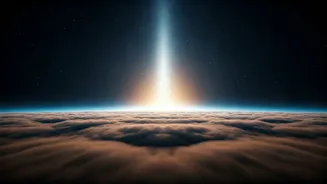
This cosmic fog didn't last forever. Gravity slowly pulled the densest regions of gas together, forming the very first stars and galaxies between 150 million and one billion years after the Big Bang. These first-generation stars were massive, incredibly hot, and unleashed torrents of powerful ultraviolet (UV) radiation. This intense light had enough energy to strip the electrons from the neutral hydrogen atoms, a process called ionization. As the first galaxies lit up, they created bubbles of clear, ionized gas around them. These bubbles grew larger and eventually merged, until the entire fog that had filled the intergalactic medium was burned away. This transformative period is known as the Epoch of Reionization.
Studying a Fog from 13 Billion Years Ago
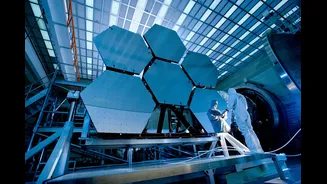
How do you study something that disappeared more than 13 billion years ago? Astronomers use the most distant objects in the universe as cosmic lighthouses. Quasars, which are extremely bright galactic cores, act as backlights. As light from a quasar travels toward us, it passes through the remnants of this ancient hydrogen fog. By analyzing which wavelengths of light get absorbed, scientists can map where the fog was thickest and how it cleared over time. Telescopes like the James Webb Space Telescope (JWST) are revolutionary for this work. Its powerful infrared instruments can detect the faint light from the earliest galaxies and see the telltale signatures of hydrogen from this bygone era, giving us a direct window into the cosmic dawn.
A Surprise Discovery Changes the Timeline
Recent discoveries have added a new wrinkle to this story. Astronomers using the JWST found a galaxy, JADES-GS-z13-1, shining brightly just 330 million years after the Big Bang—a time when the cosmic fog was expected to be extremely thick. Surprisingly, the galaxy's light was not being blocked as much as theories predicted, suggesting that a large bubble of cleared-out, ionized gas already surrounded it. This unexpected finding has challenged scientists, who now believe that the first galaxies, perhaps containing stars far more massive and luminous than we see today, may have started clearing the fog even earlier and more efficiently than previously thought.
Why This Ancient Fog Matters Today
Understanding the Epoch of Reionization is about much more than just a historical weather report for the universe. This process fundamentally shaped the cosmos we inhabit. The way the fog was cleared influenced how and where later generations of galaxies could form. By heating the gas between galaxies, reionization effectively set the stage for the large-scale structure of the universe—the cosmic web of galaxy clusters and voids we see today. Peeling back the layers of this ancient fog helps us answer some of the most fundamental questions in astronomy: When did the first stars turn on? How did the first galaxies grow? And how did the universe become the transparent, light-filled place we know and see today?