







A Crowded Highway Above
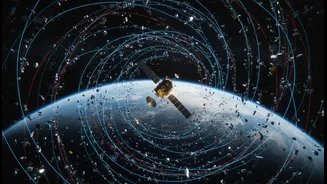
Space, particularly the low-Earth orbit (LEO) where many satellites and future crewed missions will operate, is becoming dangerously congested. Decades of launches have left a legacy of defunct satellites, spent rocket stages, and fragments from collisions
and anti-satellite tests. This orbital debris travels at mind-boggling speeds of up to 28,000 km/h. At that velocity, a collision with an object as small as a screw can be catastrophic, disabling a multi-crore satellite and creating even more debris. With thousands of new satellites from mega-constellations planned for launch, the risk of a cascade of collisions, known as the Kessler syndrome, is a growing concern for all spacefaring nations. This makes navigating space akin to driving on a highway with no traffic signals, no lanes, and thousands of speeding, driverless vehicles.
The Invisible Shield: SSA and STM
The safety layer India's space mission needs is a robust, indigenous capability in Space Situational Awareness (SSA) and Space Traffic Management (STM). SSA is the science of tracking objects in space and predicting their paths. It’s about knowing what’s up there, where it is, and where it's going. STM is the next step: using that knowledge to create rules and procedures to avoid collisions and manage the flow of traffic in orbit. For years, India, like many countries, relied on data provided primarily by the United States. However, to secure its sovereign space assets and operate with autonomy, developing its own advanced SSA capability is not a luxury, but a strategic necessity.
India’s Eye in the Sky: Project NETRA
The Indian Space Research Organisation (ISRO) is actively working to build this safety layer. The cornerstone of this effort is Project NETRA (Network for Space Object Tracking and Analysis). Initiated in 2019, NETRA is an early warning system designed to detect debris and other hazards to India's satellites. The project involves a network of radars, telescopes, and data processing centres. Its goal is to be able to track objects as small as 10 centimetres and provide advance warning of potential collisions, allowing ISRO to perform collision avoidance manoeuvres. A dedicated SSA Control Centre has been established in Bengaluru, and ISRO has been steadily expanding its network of observation facilities, including radars and optical telescopes across the country. This system, known as IS4OM (ISRO System for Safe and Sustainable Space Operations Management), is becoming the central hub for protecting India's space assets.
From Awareness to Action
While tracking is crucial, the ultimate goal is management. As ISRO prepares for the Gaganyaan human spaceflight mission, the stakes are higher than ever. Astronaut safety is paramount, and this extends beyond the launch and re-entry phases, for which ISRO has developed extensive crew escape and recovery systems. The Gaganyaan capsule must also be protected while in orbit. The data from Project NETRA will be vital for planning mission trajectories and ensuring the crewed module doesn't have any close calls with space debris. Furthermore, a strong domestic STM framework will allow India to play a leading role in shaping international norms for responsible behaviour in space. This includes everything from debris mitigation guidelines to protocols for coordinating satellite movements. As more private companies enter the space sector, clear traffic management rules become essential for both safety and commercial viability.