
A Crimson Giant in Decline
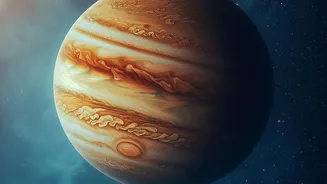
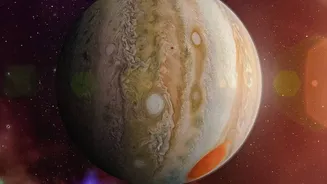
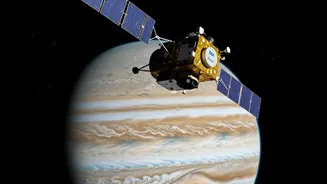
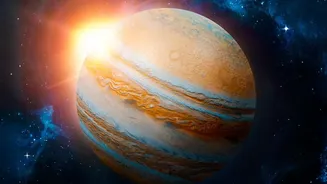
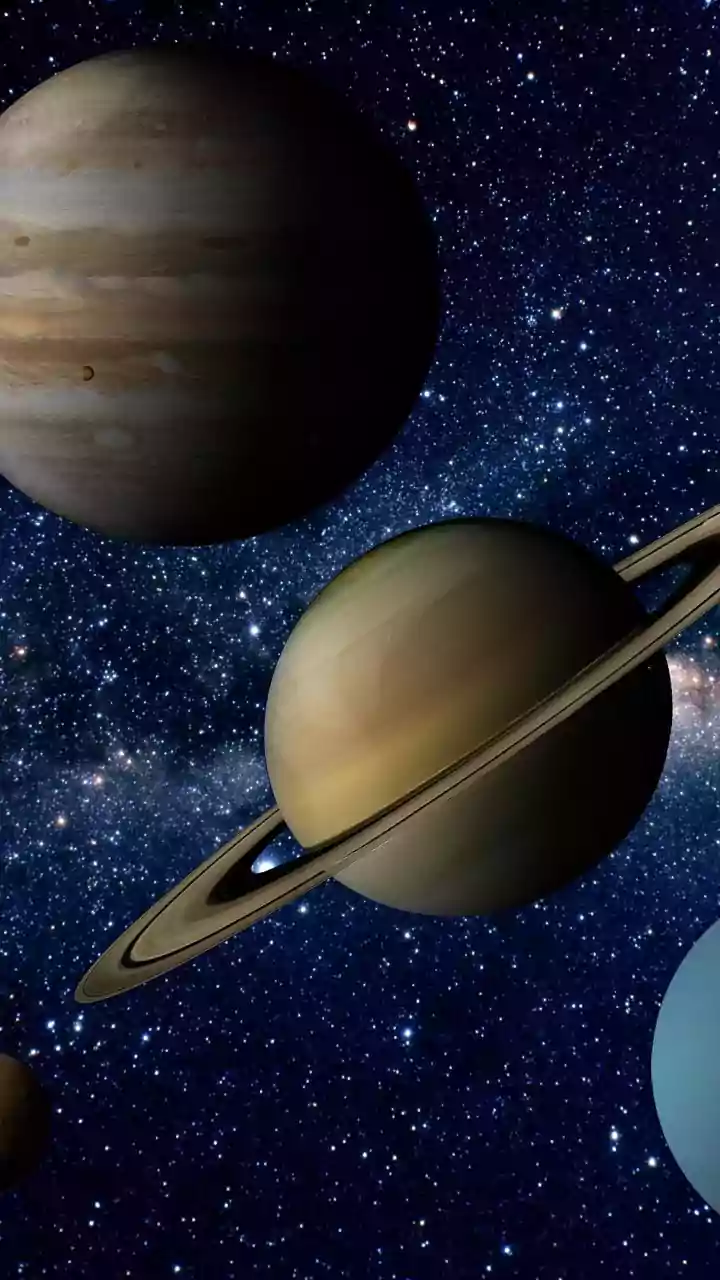
Jupiter’s Great Red Spot is the most famous storm in our solar system. It’s an anticyclone, a high-pressure system spinning counterclockwise, that has been observed for at least 150 years and possibly since the 1600s. At its peak, this crimson oval was
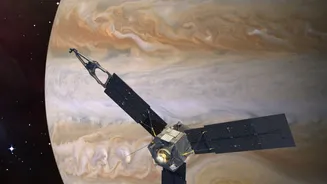
wide enough to fit three Earths inside. However, astronomers have watched it steadily shrink for the past century. In 1979, NASA's Voyager spacecraft measured it at 14,500 miles across. By 2014, Hubble observations confirmed it had shrunk to just 10,250 miles, with its oval shape becoming more circular. This consistent downsizing has become one of the biggest mysteries in planetary science.
The 'Starvation' Theory
A compelling new theory suggests the Great Red Spot isn't dying of old age but is essentially starving. Recent computer simulations indicate that the colossal storm maintains its size and strength by 'feeding' on smaller, nearby storms and eddies. This process has been observed for years, but new models show just how crucial this diet of smaller vortices is. When there are plenty of small storms to absorb, the Great Red Spot can maintain or even increase its size. However, recent observations show that the number of these smaller feeder storms on Jupiter has been declining. Without this steady source of energy and momentum, the giant storm has begun to shrink.
A Taller, More Intense Storm
Curiously, shrinking in width doesn’t mean the storm is becoming weaker. In fact, some evidence suggests the opposite. As the storm's footprint contracts, it appears to be growing taller, stretching vertically into Jupiter’s atmosphere. Think of a potter shaping clay on a wheel: as they narrow the base, the pot grows taller. This vertical stretching could be intensifying the storm's internal dynamics. Furthermore, the storm's distinct colour has deepened to a more intense orange since 2014, which might be a sign that chemicals are being pushed higher into the atmosphere and exposed to more solar radiation.
Cosmic Tornados and Earthly Connections
The dynamics of the Great Red Spot are not entirely alien. Scientists draw parallels to long-lived high-pressure systems on Earth, sometimes known as 'heat domes' or 'blocks', which are responsible for prolonged heat waves. These terrestrial systems are also sustained by interactions with smaller weather events. By studying the Great Red Spot—a 'cosmic tornado' on an unimaginable scale—we can test and refine our understanding of atmospheric physics. The insights gained from Jupiter can provide a broader context for weather patterns on our own planet and even help us understand the atmospheres of planets orbiting other stars.
An Uncertain Future
While the starvation theory provides a strong explanation, the Great Red Spot continues to surprise scientists. Recent Hubble observations revealed that the storm wobbles and that its size oscillates over a 90-day cycle, a behaviour that currently has no clear hydrodynamic explanation. Will the storm eventually disappear, like a similar feature observed in the 1600s, or will it stabilize into a new, smaller form? Scientists aren't sure. For now, the Great Red Spot remains a dynamic natural laboratory, offering clues not just about Jupiter, but about the fundamental forces that govern planetary atmospheres across the universe.