






The Promise of Tiny Accelerators
Particle accelerators are the engines of discovery in modern physics, but they are famously enormous. The Large Hadron Collider, for example, is a 27-kilometre ring. Recently, however, a new technique known as plasma wakefield acceleration has shown immense
promise. Instead of using massive magnets and radiofrequency cavities, this method uses a powerful laser or electron beam to create a wave, or 'wake,' in a plasma—a superheated gas of charged particles. Trailing particles can then 'surf' this wake, achieving enormous energies over incredibly short distances. Researchers have demonstrated acceleration gradients up to 1,000 times greater than conventional methods. This has opened the door to the concept of 'tabletop' accelerators, powerful enough for advanced research but small and cheap enough to become ubiquitous in science and medicine. The breakthrough represents a potential democratisation of high-energy physics.
NASA's Cosmic GPS
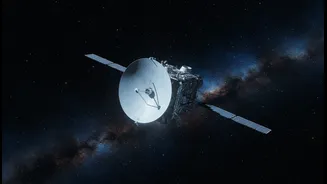
As humanity looks toward deep space, one of its biggest challenges is navigation. The GPS that guides us on Earth won't work between planets or stars. For that, NASA and other agencies are developing an ingenious solution called pulsar-based navigation, sometimes dubbed the 'Lighthouse Pulsar Map'. Pulsars are the super-dense, spinning remnants of massive stars. They emit beams of radiation, like a cosmic lighthouse, with a regularity that can rival atomic clocks. By equipping a spacecraft with a sensitive X-ray detector, it can measure the precise arrival times of signals from several different pulsars. By comparing these signals to a known database of pulsar locations and timings, the spacecraft could calculate its own position in three-dimensional space, completely independent of Earth. This would grant future missions an unprecedented level of autonomy.
Where the Breakthrough Falls Short
This is where the two concepts collide. The instruments needed for a pulsar map must be sensitive enough to detect faint X-ray signals, but also robust enough for long-duration space missions. A new generation of compact particle accelerators could, in theory, be used to create onboard calibration sources or even enhance detector technology. However, the recent breakthroughs in plasma wakefield acceleration come with a significant caveat: they are currently best at accelerating electrons to very high energies. While immensely powerful, the output can sometimes lack the precise control and specific particle characteristics needed for ultra-sensitive measurements. The process can introduce energy spread or jitter in the resulting particle beam, which is problematic for an instrument that relies on timing signals down to the nanosecond. The raw power is there, but the finesse required for the pulsar map's delicate work is not yet fully developed.
An Energy and Precision Mismatch
The core of the problem is a mismatch between the kind of energy the new accelerators produce and what pulsar navigation needs. The goal of pulsar timing is absolute precision. Any interference or instability in the detector systems can throw off a position calculation by thousands of kilometres. While plasma wakefield methods can generate extremely high peak energies, they can also create a wide spectrum of lower-energy particles and secondary radiation that can become noise in a sensitive detector. Furthermore, some theoretical designs for advanced pulsar detectors might require the acceleration of particles other than electrons, like protons or ions, which current compact systems are less efficient at handling. So, while one technology has taken a giant leap in brute force, it has yet to master the delicate touch needed for this specific application.
The Path Forward
This limitation doesn't diminish the particle acceleration breakthrough. Its applications in medicine, materials science, and fundamental physics are still revolutionary. For NASA's pulsar navigation, however, it means that progress will continue to rely on improving the sensitivity of X-ray telescopes like the IXPE instrument and refining data analysis techniques. Scientists are working to overcome the current limitations of plasma accelerators, exploring ways to create more stable, 'cleaner' beams with less energy spread. Future iterations may well solve these issues, eventually providing the perfect compact tool for calibrating a cosmic GPS. But for now, the incident serves as a classic reminder of how scientific progress works: one great leap in a single field doesn't automatically solve every challenge across all of science and engineering. The journey to the stars will require not just powerful breakthroughs, but the patient work of adapting and refining them.