




Hunting for Water in the Cosmos
For centuries, the idea of alien worlds was confined to science fiction. Today, thanks to powerful instruments like the James Webb Space Telescope (JWST), we have confirmed the existence of thousands of planets outside our solar system, known as exoplanets.
One of the most exciting capabilities of these new observatories is the ability to analyse the atmospheres of these distant worlds. By watching how a star's light changes as it passes through a planet's atmosphere, a method called spectroscopy, scientists can identify the chemical signatures of different molecules. Water vapour is one of the most sought-after signatures, and JWST has already detected it in the atmospheres of several exoplanets, including those in the regions where rocky planets might be forming.
Vapour is Not an Ocean
Finding water vapour in an exoplanet's atmosphere is a monumental scientific achievement. It confirms that a key ingredient for life as we know it exists beyond our solar system. However, it is a long and uncertain leap from detecting water in the air to confirming the presence of vast, liquid oceans on a planet's surface. A planet needs to be in the 'habitable zone'—often called the 'Goldilocks zone'—where temperatures are just right for water to remain liquid. If a planet is too hot, any water will boil off into space; too cold, and it will be locked up as ice. Atmospheric pressure also plays a crucial role. Earth's atmosphere is what prevents our oceans from boiling away.
The Case of K2-18 b
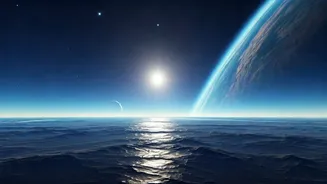
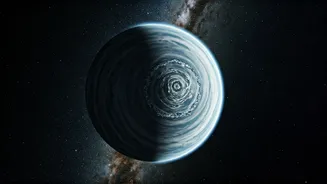
A prime example of both the excitement and the complexity of this search is the exoplanet K2-18 b, located about 120 light-years away. Initial observations with the Hubble and later the JWST found water vapour, methane, and carbon dioxide in its atmosphere, leading to suggestions that it could be a 'Hycean' world—a hot planet covered by a global ocean with a hydrogen-rich atmosphere. Some studies even detected faint hints of dimethyl sulfide (DMS), a gas that on Earth is predominantly produced by marine life like phytoplankton. However, the scientific community is far from a consensus. Other analyses suggest K2-18 b may be a gassy 'mini-Neptune' with no defined surface at all, where temperatures and pressures would be far too extreme for liquid water. This ongoing debate highlights how challenging it is to interpret the data we receive from these distant worlds.
Beyond Water: The Search for Biosignatures
Ultimately, finding an alien ocean is not just about water. Scientists are searching for a whole suite of 'biosignatures'—gaseous clues that strongly indicate the presence of life. On Earth, life has completely transformed our atmosphere, filling it with oxygen. For a distant world, a combination of gases that shouldn't exist together without a constant biological source—like methane and carbon dioxide in certain ratios—could be a powerful sign of life. The presence of water vapour is a foundational clue because it provides the necessary environment. But confirming an ocean, let alone life within it, will require detecting a complex atmospheric cocktail that can only be explained by biology.