
A Panoramic View of the Cosmos
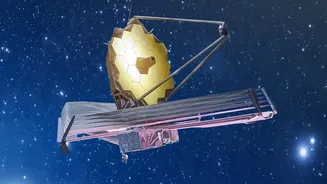
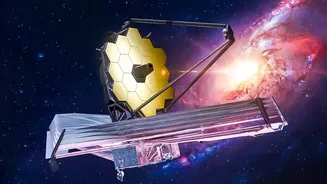
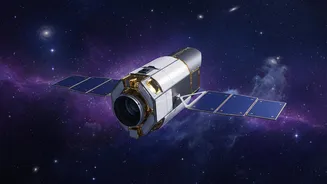
The most significant difference between Roman and Hubble is the sheer scale of their vision. While both telescopes have primary mirrors of the same size—2.4 meters in diameter—Roman is designed for cosmic panoramas. Its Wide Field Instrument can capture
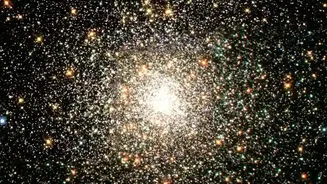
an area of the sky at least 100 times larger than Hubble can in a single snapshot, all while maintaining a similar, tack-sharp resolution. Imagine trying to take a picture of a massive crowd. Hubble would be like focusing on one person's face with incredible detail. Roman, by contrast, would capture the entire crowd in one shot, with each face still clearly visible. This wide-angle capability will allow Roman to survey the sky at a blistering pace, mapping more than 50 times the area Hubble covered in 30 years within its initial five-year mission.
New Ways to Hunt for Planets
Hubble has contributed to exoplanet science, but Roman is a planet-hunting machine by design. It will employ multiple methods, most notably gravitational microlensing. This technique looks for a brief spike in light that occurs when a star and its planets pass in front of a more distant star, with the closer system's gravity acting as a lens to magnify the background light. This method is particularly effective at finding planets orbiting far from their star and even so-called 'rogue planets' that don't orbit a star at all—worlds Hubble wasn't designed to find. In addition to microlensing, Roman is expected to find around 100,000 planets using the more traditional transit method, where a planet periodically dims its star's light. It is a statistical powerhouse, built to conduct a massive census of the planets in our galaxy.
Probing the Universe's Biggest Mysteries
While Hubble’s discoveries have reshaped astrophysics, Roman’s primary mission is to tackle two of the biggest puzzles in cosmology: dark energy and dark matter. Dark energy is the mysterious force thought to be causing the universe's expansion to accelerate, and dark matter is the unseen substance that accounts for most of the universe's mass. Roman will map the distribution of galaxies and dark matter across cosmic time and space by observing millions of galaxies and thousands of distant supernovae. Its vast surveys will create unprecedented 3D maps of the universe, allowing scientists to study how dark energy has shaped cosmic evolution. This focus on large-scale structure is a fundamental departure from Hubble’s deep dives into specific objects.
Seeing Stars in a New Light
Both telescopes see in infrared light, but their capabilities are tuned for different jobs. Hubble has a broader wavelength range, covering ultraviolet, visible, and near-infrared light. Roman focuses on visible to near-infrared light, optimized for its wide-field surveys and for peering through cosmic dust. A key technological leap for Roman is its Coronagraph Instrument. This is an advanced piece of technology designed to block the overwhelming glare from a star, allowing astronomers to directly image the faint planets orbiting it. This instrument is a technology demonstration that will be up to a thousand times more effective than previous efforts, paving the way for future missions aiming to photograph Earth-like worlds.
A Complementary Partnership
Ultimately, Roman is not a 'better' Hubble; it’s a different tool for a different set of scientific questions. The two missions are designed to be complementary. Roman will act as a cosmic scout, efficiently identifying rare and interesting objects—whether they be unusual galaxies, flaring stars, or potential new worlds—across vast stretches of the sky. Once Roman finds these targets, telescopes like Hubble and the James Webb Space Telescope can perform the detailed, zoom-lens follow-up observations. Roman will provide the context, painting the big picture of cosmic ecosystems, while its siblings zoom in to study the individual details that make our universe so fascinating.