




The Allure of the Ache
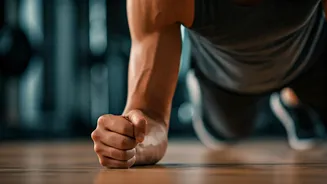
In gyms and fitness classes across India, there's a shared understanding: if you're not sore, you didn't work hard enough. This belief is rooted in the idea that to build muscle, you must first break it down. The resulting pain, known as Delayed Onset
Muscle Soreness (DOMS), feels like proof of progress. It’s a tangible signal that you pushed your limits. This feeling can be motivating, assuring you that the effort you put in is physically manifesting. However, the connection between how sore you feel and how much stronger you're getting is much weaker than most people believe. While soreness can mean you've challenged your body, it's far from the most reliable metric for growth.
Decoding Delayed Onset Muscle Soreness
So, what is that next-day pain, really? DOMS is the muscle pain and stiffness that typically begins 12 to 24 hours after a workout. It’s the result of microscopic tears in your muscle fibers, especially from activities your body isn’t used to or from eccentric movements (like the controlled lowering part of a bicep curl). Your body’s response is to increase inflammation to repair this microtrauma, which leads to the characteristic tenderness and stiffness. Think of it less as a direct signal of muscle growth and more as a sign of novelty. As your body adapts to a specific exercise or intensity, you'll experience less soreness from it, even if the workout remains effective. This is why your first few weeks of a new program might leave you waddling, while later weeks feel much less painful despite you lifting heavier.
An Unreliable Narrator
Relying on soreness to measure your workout's effectiveness is like judging a meal only by how full you feel. It's one factor, but it doesn't tell the whole story. Some muscle groups, like shoulders and calves, are less prone to soreness but can still grow significantly. Furthermore, extreme soreness can be counterproductive. If you're too sore to move properly, you might compromise your form in your next workout or skip it altogether, hindering consistency. Research shows that muscle damage, which causes soreness, is not a prerequisite for muscle growth. You can build significant strength and size with minimal soreness once your body is well-conditioned. The absence of pain doesn't mean the absence of progress.
What to Chase Instead of Pain
If soreness isn't the goal, what is? The gold standard for building strength is a principle called 'progressive overload'. This simply means gradually increasing the demand placed on your muscles over time. Instead of chasing a feeling, you should chase tangible improvements in your performance. There are several ways to apply progressive overload: increasing the weight you lift, doing more repetitions or sets with the same weight, reducing your rest time between sets, or improving your form and range of motion. Keeping a workout journal to track these variables is one of the most effective ways to ensure you're consistently challenging your body and making real, measurable progress toward your strength goals.
Good Soreness vs. Bad Pain
It's also crucial to distinguish between normal muscle soreness and the pain of an injury. DOMS typically presents as a dull, generalized ache in the muscles you worked, peaking around 24 to 72 hours later and then gradually subsiding. The discomfort is usually felt when the muscle is stretched or contracted. In contrast, injury-related pain is often sharp, sudden, and localized to a specific spot. It might also be accompanied by swelling or bruising and can hurt even when you're at rest. While a bit of soreness is a normal part of training, sharp or persistent pain is a signal to stop and rest. Pushing through an injury in the name of 'no pain, no gain' can lead to serious setbacks.