




More Than Just Dust
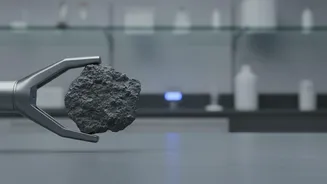
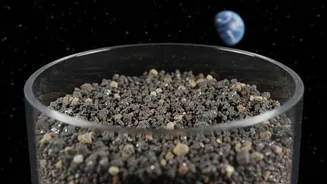
To a casual observer, it’s just grey dirt. But to scientists, lunar regolith—the blanket of crushed rock, mineral fragments, and glass shards covering the Moon—is a priceless time capsule. Unlike Earth, where wind, water, and life constantly churn and erase
the geological record, the Moon has no atmosphere and minimal geological activity. This means its surface has been patiently collecting evidence for billions of years. Every micrometeorite impact, every blast of solar wind, and every particle from the distant cosmos is recorded in this soil. By studying it, we aren't just learning about the Moon; we're reading a 4.5-billion-year-old history book of our entire cosmic neighbourhood.
Revelations from the Apollo Era
The 382 kilograms of rock and soil returned by the Apollo missions between 1969 and 1972 fundamentally rewrote our understanding of the Moon. Analysis proved the Moon wasn't a cold, unchanging rock but had a dynamic, molten past, including vast volcanic eruptions. The samples provided the strongest evidence for the 'giant-impact hypothesis'—the theory that the Moon formed from debris after a Mars-sized object collided with early Earth. For decades, these precious samples continued to yield surprises, including the discovery of trace amounts of water trapped within volcanic glass beads, hinting that the Moon wasn't entirely dry. The age of the rocks helped scientists calibrate the timeline of impacts across the inner solar system, giving us a better grasp of Earth's own turbulent youth.
The New Race for Resources and Knowledge
Today, a new generation of lunar missions from multiple nations is underway, and soil remains a primary target. China's Chang'e-5 mission returned the first new samples in over 40 years in 2020. Analysis of this soil, from a previously unexplored region, revealed that volcanic activity on the Moon persisted until as recently as two billion years ago—a billion years later than scientists had thought. Meanwhile, NASA’s Artemis program aims to land astronauts near the South Pole, a region believed to hold vast quantities of water ice in permanently shadowed craters. This water isn't just for drinking; it can be split into hydrogen and oxygen to create breathable air and, crucially, rocket propellant. Mastering the use of these local resources, or 'in-situ resource utilization', is the key to establishing a sustainable human presence on the Moon and venturing further to Mars.
India's Pivotal Role in Lunar Science
India has firmly established itself as a key player in this new lunar chapter. The Chandrayaan-1 mission in 2008, carrying a NASA instrument, provided definitive confirmation of water molecules on the lunar surface. More recently, the historic landing of Chandrayaan-3 near the South Pole provided the first-ever in-situ measurements of the soil in this strategic region. Its instruments detected the presence of sulfur, something not easily done from orbit, and its thermal probe studied how heat travels through the topsoil. These findings are vital for future missions that will hunt for water ice, as they help scientists understand the surface conditions and narrow down where ice could remain stable just below the surface.
A Future Fuelled by Moon Dust?
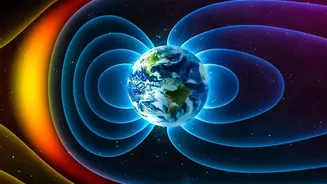
Perhaps the most tantalising clue hidden in the lunar soil is a rare isotope called Helium-3. Blasted onto the lunar surface by the solar wind for eons, Helium-3 is extremely scarce on Earth, which is protected by its magnetic field. Scientists believe Helium-3 could be a near-perfect fuel for nuclear fusion, the same process that powers the Sun. A fusion reactor running on Helium-3 would generate immense clean energy without producing the long-lived radioactive waste of traditional nuclear fission. While the technology for Helium-3 fusion is still in development, and the economics of mining it are a major challenge, the prospect has several nations and private companies intensely interested. The soil that tells us about our past may very well hold the key to powering our future.