





The Ghost in the Machine
Imagine trying to take a photo in a smoke-filled room. The result would be a blurry, indistinct haze. For decades, this was the challenge astronomers faced when looking at some of the most interesting objects in the early universe: dusty starburst galaxies.
A prime example is an object named AzTECC71. To ground-based telescopes, it appeared as a faint blob. To the powerful Hubble Space Telescope, it was completely invisible, a ghost in the cosmic dark. Astronomers knew something was there, a galaxy furiously creating hundreds of new stars every year, but it was hidden behind an impenetrable veil of cosmic dust. These 'Hubble-dark galaxies' were cosmic mysteries, thought to be rare but crucial to understanding how the universe evolved just after the Big Bang.
An Infrared Eye on the Cosmos
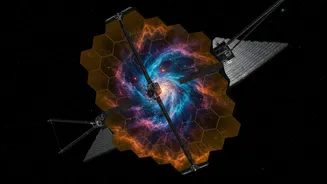
This is precisely the kind of challenge the James Webb Space Telescope (JWST) was built for. While Hubble primarily sees the universe in visible and ultraviolet light, which is easily blocked by dust particles, Webb is designed to see in infrared. Think of it like a pair of thermal goggles that can see a person's heat signature through smoke. The dust that blinds Hubble is no match for Webb's instruments. The light from the stars within AzTECC71 is absorbed by the dust, which then heats up and re-emits that energy at longer, infrared wavelengths. Webb's near-infrared camera, NIRCam, is perfectly tuned to capture this faint, ancient glow, allowing it to pierce the dusty shroud and see what lies beneath. This capability has single-handedly opened a new window onto a previously hidden population of galaxies.
From a Blob to a Bonfire
When astronomers with the COSMOS-Web project pointed Webb at the spot where AzTECC71 was supposed to be, the ghost finally appeared. What was once a single, indistinct blob in other telescopes resolved into a faint but clear galaxy. This wasn't just a prettier picture; it was a revelation. The detailed image showed that AzTECC71, located nearly 13 billion light-years away, was forming stars at a monstrous rate. One researcher described it as a 'real monster' for its sheer productivity, churning out hundreds of stars each year compared to the Milky Way's handful. The fact that something so extreme was barely visible even to Webb suggests that our previous census of the early universe might have missed a significant number of these cosmic factories.
Rewriting the Story of the Early Universe
The discovery of AzTECC71 and others like it is more than just a technical achievement; it's forcing a rewrite of our understanding of cosmic history. These dusty star-forming galaxies were once thought to be extremely rare in the early universe. However, early results from Webb suggest they could be up to 10 times more common than previously expected. This implies that the early universe was a much dustier place than models had predicted. These galaxies represent a critical phase of galactic evolution, where mergers and intense bursts of star formation rapidly built up the massive structures we see today. By finally being able to see these hidden galaxies in detail, astronomers can now test theories about how galaxies grow, how they regulate their star formation, and how they interact with their cosmic environments. The detail from a dusty smudge provides a direct look at the chaotic, yet formative, processes that shaped the cosmos.