



Not Solid, But a Swarm
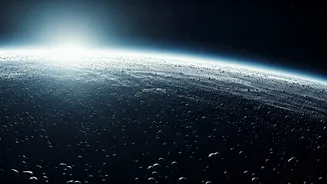
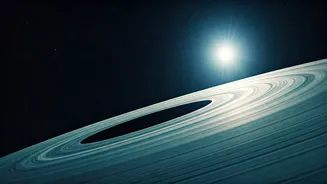
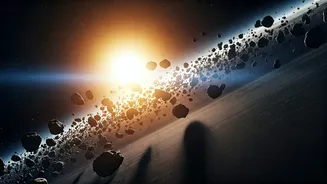
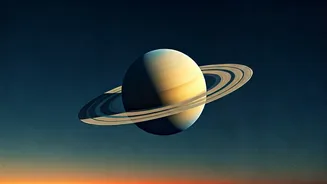
The first thing to understand about Saturn’s rings is that they are not solid objects. You couldn't land a spaceship on them or walk across them. Instead, they are an enormous, flat disc made of countless individual particles of ice and rock. These particles all
orbit Saturn together, like a vast, glittering swarm of mini-moons. Think of it less like a cosmic hula hoop and more like a celestial highway with billions of cars, each staying in its own lane but moving at incredible speeds—up to 80,000 kilometres per hour. This structure is so complex that from afar it appears smooth, but it is in fact a dynamic and ever-changing environment.
A Blizzard of Water Ice
So what are these billions of particles made of? The answer is surprisingly simple: mostly water ice. Data from space probes, especially the Cassini mission which spent 13 years studying Saturn, revealed that the rings are about 99.9% pure water ice. The remaining fraction is a mix of rocky materials and dust, which gives the rings their subtle colours, ranging from bright white to a soft tan. The purity of the ice is a major clue for scientists trying to figure out the rings' age. If they were as old as Saturn itself, they would likely be much darker, having collected more cosmic dust over billions of years. Their brightness suggests they might be a relatively recent addition to the solar system, perhaps only 100 million years old.
From Dust Specks to Mountains
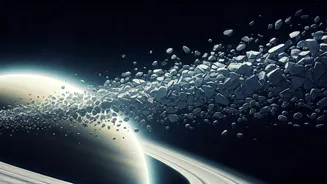
The phrase “billions of moving floating cosmic rocks” is wonderfully accurate because the size of these icy particles varies tremendously. The vast majority are tiny, like grains of sand or specks of dust. Many others are the size of pebbles or small stones. But scattered throughout the rings are much larger objects. Some are the size of a car, while the biggest can be as large as a house or even a small mountain, several kilometres across. These larger chunks are sometimes called 'moonlets.' It is this incredible diversity in size, all swirling together, that makes the rings so structurally complex and visually stunning up close.
Impossibly Wide, Incredibly Thin
One of the most mind-bending facts about Saturn’s rings is their scale. The main rings stretch up to 282,000 kilometres in diameter. If you were to place them over Earth, they would stretch from our planet almost all the way to the Moon. Yet, for all that width, they are astonishingly thin. In most places, the rings are only about 10 to 100 metres thick. To put that in perspective, if you made a scale model of the rings out of paper that was the size of a football field, the paper would be far, far thicker than the rings are to scale. This extreme thinness is why they can appear to vanish completely when viewed edge-on from Earth.
The Dance of the Shepherd Moons
The rings aren't just a free-for-all. Their beautiful, sharp-edged structure, with clear gaps and divisions, is maintained by gravity. Saturn's many moons play a crucial role, but some of the most important are the tiny 'shepherd moons' that orbit within or near the rings. Moons like Prometheus and Pandora act like cosmic sheepdogs, using their gravitational pull to herd the ring particles, keeping them in narrow, well-defined bands. Their gravity pulls stray particles back into line, preventing the rings from spreading out and dissipating. This gravitational dance creates the intricate patterns, waves, and ripples that Cassini observed in breathtaking detail.