








The Challenge of a Cloudy Day
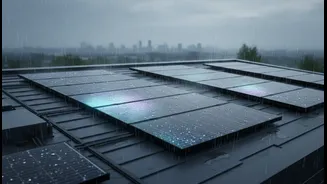
Conventional solar panels, typically made from silicon, are at their best under bright, direct sunlight. When clouds, haze, or even dense urban smog scatter that light, their efficiency can drop significantly. On heavily overcast days, a standard solar panel might
only produce 10% to 25% of its rated power. For a country like India, which experiences a prolonged monsoon season and has urban centres with notable air pollution, this variability is a major hurdle. It complicates the goal of relying on solar power as a consistent, round-the-clock energy source and impacts the financial viability of large-scale solar farms and rooftop installations.
A New Generation of Materials
The most exciting developments are happening with a class of materials called perovskites. These are not a specific element, but rather a family of compounds with a unique crystal structure that is exceptionally good at absorbing light. Unlike rigid silicon panels, perovskite materials can be formulated into thin, flexible, and even semi-transparent films. Another promising category is organic photovoltaics (OPV), which use carbon-based polymers to convert light into electricity. These materials are lightweight, can be produced at lower costs, and can be specifically engineered to capture different wavelengths of light, making them highly adaptable.
How They Capture Diffused Light
The key advantage of materials like perovskites is their ability to absorb a broader spectrum of light more efficiently. While traditional silicon is great with direct sunlight, these next-generation materials are more sensitive to the ambient and indirect light that filters through clouds. Think of it like getting a sunburn on an overcast day; harmful UV rays still get through the clouds, and in a similar way, energy-rich light still reaches the ground. Perovskites and certain organic materials are simply better at capturing this scattered, or 'diffuse', light and converting it into electrical energy. Some of these materials can be combined with traditional silicon in what are known as tandem cells, which use multiple layers to capture different parts of the light spectrum, boosting overall efficiency.
A Potential Boon for India's Energy Goals
For India, a nation targeting 500 GW of renewable energy capacity by 2030, this technology could be transformative. More efficient performance in low-light conditions would make solar power far more reliable during the four-month monsoon season, increasing the energy yield and improving the return on investment for solar projects. In northern cities that grapple with winter fog and haze, or in dense urban environments where buildings cast long shadows, these panels could generate more power than their conventional counterparts. Technologies like Heterojunction (HJT) cells, which also perform well in high temperatures, are particularly suited to the Indian climate. This increased efficiency directly supports national initiatives and could accelerate the adoption of solar power across the country.
The Road from Lab to Rooftop
Despite the immense promise, challenges remain. The long-term stability of perovskite cells has been a major concern, as early versions tended to degrade when exposed to moisture and heat. However, recent research has made significant strides in improving their durability. Scientists are developing new formulations and protective layers to extend the operational lifetime of these cells to meet commercial standards. The next hurdles are scaling up manufacturing to reduce costs and proving their performance and stability over many years in real-world outdoor conditions, not just in the lab. While commercialisation is still on the horizon, the pace of innovation is rapid, with researchers consistently reporting higher efficiencies and better stability.