



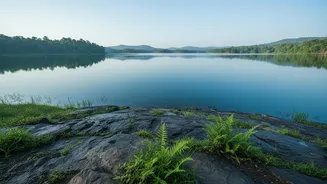
A Climate Secret in a Chhattisgarh Lake
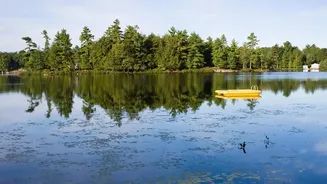
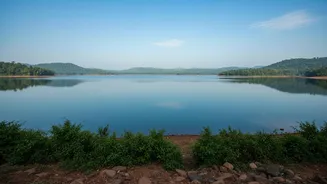
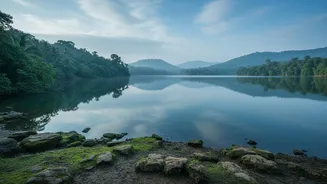
In what sounds like a scientific adventure story, researchers from the Birbal Sahni Institute of Palaeosciences (BSIP) have uncovered evidence of a dramatically different past in central India. By studying the Raja Rani Lake in Chhattisgarh’s Korba district,
they found that the Indian Summer Monsoon was significantly stronger and more intense about a thousand years ago. This discovery was made by drilling into the lakebed and extracting a core of sediment—a vertical slice of mud that has been accumulating for centuries. This unassuming mud contains a detailed environmental record going back about 2,500 years. The findings specifically point to a period between 1060 and 1725 CE, known globally as the Medieval Climate Anomaly, where the climate in the region was warmer, more humid, and received much more rainfall than previously thought. This challenges some existing ideas about India's historical climate patterns.
The Power of Ancient Pollen
So, how can mud tell us about ancient rainfall? The answer lies in palynology—the study of microscopic pollen grains. Every year, plants release vast quantities of pollen into the air. This pollen settles on the ground and in bodies of water, eventually becoming buried in layers of sediment. Since the tough outer shells of pollen grains can survive for millennia, they become tiny, time-stamped fossils. By identifying the types of pollen in each layer of the lake sediment core, scientists can reconstruct what kind of vegetation was growing at that specific time. For example, an abundance of pollen from forest-loving plants points to a warm and humid climate with plenty of rain. Conversely, a shift to pollen from grasses and herbs would suggest drier conditions. This is precisely what the BSIP scientists tracked through the layers of the Raja Rani Lake core.
Why Lake Sediments Are a Perfect Archive
The headline's focus on checking lake sediments is crucial because lakes are nature’s perfect history books. Unlike land-based records that can be disturbed by erosion or human activity, the bottom of a calm lake offers a relatively undisturbed setting. Year after year, season after season, a fine layer of silt, organic matter, and airborne particles like pollen settles on the lakebed. This creates a chronological library, with the newest layers at the top and the oldest at the bottom. By extracting a long, cylindrical core of this sediment, scientists can travel back in time. Each centimetre of the core represents a chapter in the region’s environmental history, allowing researchers to observe long-term changes in climate, vegetation, and even human impact with remarkable precision.
Why Ancient Weather Matters Today
Reconstructing the climate of a thousand years ago isn't just an academic exercise; it has profound implications for India’s future. The Indian Summer Monsoon is the lifeblood of the subcontinent, critical for agriculture, water security, and the economy. Understanding its natural variability—how it behaved in the past without modern human influence—is essential for creating accurate climate models to predict its future behaviour. This study from Chhattisgarh is especially important because the region lies within India's Core Monsoon Zone (CMZ), an area highly sensitive to monsoon fluctuations. By learning how and why the monsoon intensified during the Medieval Climate Anomaly, scientists can better understand the forces that drive it and improve our ability to forecast its patterns in a warming world, ultimately helping to safeguard our food and water resources.