




Catching a Planet's Shadow
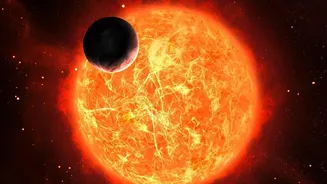
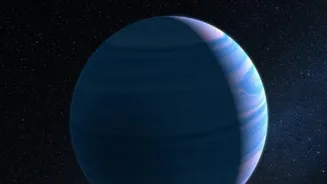
The primary method for studying an exoplanet’s atmosphere is called transmission spectroscopy. It relies on a specific alignment: the planet must pass in front of its star from our point of view, an event known as a transit. As the planet transits, a tiny
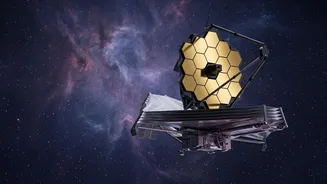
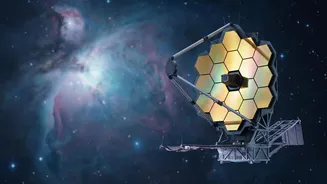
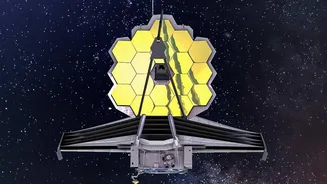
fraction of the starlight filters through the very edge of the planet’s atmosphere. This is the moment the James Webb Space Telescope is waiting for. Before the planet passes, Webb first measures the pure, unfiltered light from the star to get a baseline reading. Then, as the planet transits, it captures the light again, only this time it carries the chemical fingerprints of the atmosphere it just passed through.
The Power of Infrared Light
The JWST is a specialist in detecting infrared light, which is invisible to the human eye but crucial for this type of science. Many of the most interesting molecules that can tell us about a planet—like water, methane, and carbon dioxide—leave their most distinct signatures in the infrared part of the light spectrum. While telescopes like Hubble have studied atmospheres before, Webb's unparalleled sensitivity to a wider range of infrared wavelengths allows it to see these chemical fingerprints with much greater clarity and detail than ever before. This lets scientists detect not just the presence of a gas, but also gain insights into its abundance.
Splitting Light into a Rainbow
Once the telescope captures the star's light, its specialised instruments called spectrographs get to work. The primary tools for this job are the Near-Infrared Spectrograph (NIRSpec) and the Mid-Infrared Instrument (MIRI). A spectrograph works like a very sophisticated prism, splitting the incoming light into its component wavelengths, creating a 'rainbow' or spectrum. When light passes through an exoplanet's atmosphere, the different gas molecules absorb very specific wavelengths of that light. This absorption creates dips or missing pieces in the starlight’s spectrum. Each gas has a unique barcode-like pattern of absorption lines.
Decoding the Chemical Barcode
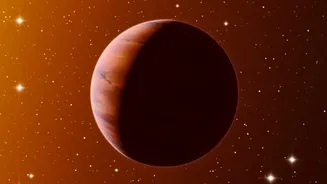
By analysing this spectrum, scientists can see which wavelengths of light are missing and match them to the known absorption patterns of different molecules. A dip at one specific infrared wavelength indicates the presence of water vapour, while a dip at another signals carbon dioxide. For example, observations of the hot gas giant WASP-39 b revealed definitive evidence of carbon dioxide, water, sodium, and even sulphur dioxide in its atmosphere. The detection of sulphur dioxide was particularly exciting, as it pointed to active chemical reactions being triggered by the light from the host star—a process known as photochemistry.
From Data to Understanding
Identifying these gases is the first step in painting a complete picture of a distant world. The presence and ratios of molecules like carbon dioxide and methane can tell astronomers about a planet's formation history—was it formed close to its star or farther out in its solar system?. The data helps classify planets, distinguishing between massive gas giants, smaller ice giants, and rocky terrestrial worlds that might be similar to Earth. While a planet like WASP-39 b, with a temperature of 900°C, is not habitable, the techniques perfected by studying it are paving the way for analysing the atmospheres of smaller, cooler, rocky planets. These are the worlds where JWST might one day find the combination of gases that could hint at conditions suitable for life.