


The Anatomy of a Powerful Movement
Often called the 'king of exercises', the squat is a compound movement, meaning it engages multiple joints and muscle groups at once. This efficiency is what makes it so effective. When you perform a squat, you're primarily working the major muscles of your
lower body. The upper legs, in particular, do most of the heavy lifting. This includes the quadriceps at the front of your thigh, the hamstrings at the back, and the adductors on the inside. But it doesn't stop there; squats also fire up your glutes (buttocks), calves, and core muscles, which work hard to keep you stable and balanced.
Quadriceps: The Engine of the Squat
The quadriceps, or 'quads', are a group of four muscles on the front of your thigh that are the primary drivers of the squat. As you lower your body into the squat, the quads work eccentrically (lengthening under tension) to control your descent. When you push back up to a standing position, they contract concentrically (shortening) to extend your knees. This is where the real power phase of the movement happens. A well-executed squatting routine is one of the most effective ways to build strength and definition in the front of your thighs.
Hamstrings: The Essential Stabilisers
While the quads provide the push, the hamstrings—the muscles running along the back of your thighs—play a crucial supporting role. During the downward phase, the hamstrings engage to help stabilise your knee joint and control the movement. As you rise, they work alongside your glutes to extend your hips, providing a powerful assist to complete the lift. This balanced activation between the front and back of the thigh is key for building functional strength and reducing the risk of injury.
Adductors and Abductors: The Supporting Cast
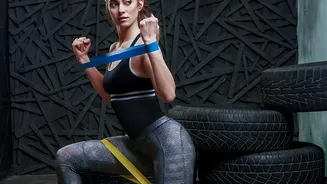
Beyond the main movers, squats also engage the smaller muscles of the inner and outer thigh. The adductor muscles, located on your inner thigh, work hard to stabilise your legs and prevent your knees from collapsing inward—a common mistake. Meanwhile, muscles on the outside of your hips, like the gluteus medius, act as abductors to help keep your knees tracking properly over your feet. This full engagement ensures that you're building balanced, stable strength across the entire upper leg.
Mastering the Bodyweight Squat
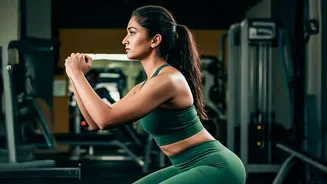
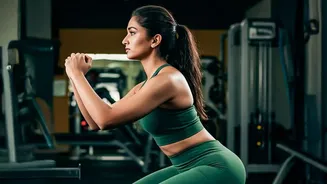
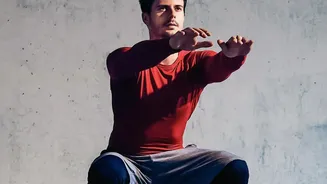
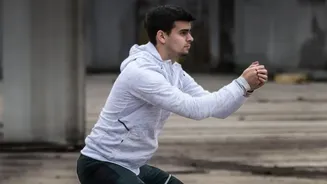
Proper form is crucial to get all these benefits and avoid injury. To perform a basic bodyweight squat, stand with your feet shoulder-width apart, with your toes pointing slightly outward. Engage your core by bracing your abdominal muscles. Begin the movement by pushing your hips back as if you're about to sit in a chair, then bend your knees. Keep your chest up and your back straight, ensuring your knees track in line with your toes and don't collapse inward. Lower yourself until your thighs are at least parallel to the floor, then drive through your heels to return to the starting position.
At-Home Variations to Deepen the Work
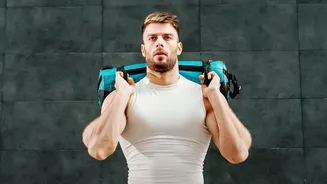
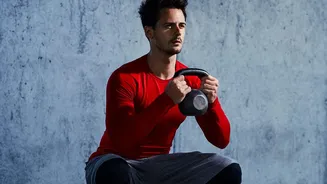
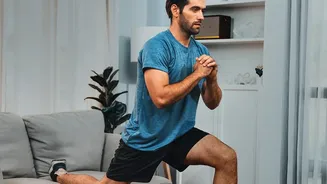
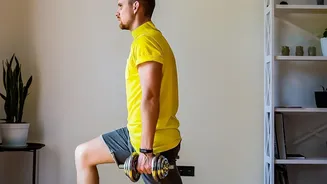
Once you've mastered the basic squat, you can introduce variations to challenge your muscles in new ways. A 'Sumo Squat', with a wider stance and toes pointed further out, increases the focus on the inner thighs (adductors) and glutes. For more quad-focused work, try an isometric 'Wall Sit', holding the bottom position of a squat with your back against a wall. You can also perform 'Goblet Squats' by holding a heavy object like a kettlebell or even a large water bottle against your chest, which provides a counterbalance that helps you maintain an upright torso and squat deeper, engaging your core even more.