






Meet Aphelion: Earth's Annual Long-Distance Moment
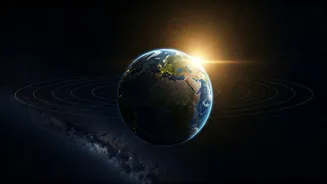
This event has a scientific name: aphelion. On July 6, 2026, Earth will reach the point in its orbit that is farthest from the Sun. The name itself comes from Greek, where 'apo' means away and 'helios' means sun. At this point, our planet will be approximately
152.1 million kilometres away from our star. It’s a staggering distance, but it’s only about 3% farther than our average distance. At the opposite end of our orbit, in early January, we experience 'perihelion', our closest approach to the Sun, when we are roughly 5 million kilometres nearer. This annual cycle of moving slightly farther away and then closer is a normal part of our planet’s journey.
An Orbit Isn't a Perfect Circle?
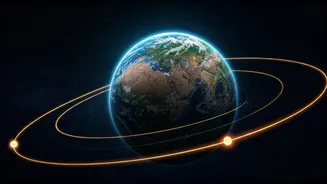
If you picture Earth’s orbit as a perfect circle with the Sun dead in the centre, you’re not alone—but it’s a common misconception. In reality, as the 17th-century astronomer Johannes Kepler discovered, planets travel in elliptical, or oval-shaped, paths. The Sun isn’t at the exact centre of this ellipse but at one of the focal points. This means our distance from the Sun naturally changes throughout the year. It’s not a dramatic shift, but it’s the reason we have an aphelion and a perihelion in the first place. This slight oval shape is the secret behind our planet's varying distance to its star.
The Big Question: So Why Is It Still Hot?
This is the most counter-intuitive part. If we’re farther from the heat source, shouldn't it be colder? The answer is a definitive no, and the reason is the true cause of our seasons: Earth’s axial tilt. Our planet is tilted on its axis by about 23.5 degrees. The seasons are determined by which hemisphere is tilted toward the Sun, not by our distance from it. During aphelion in July, the Northern Hemisphere—where India is located—is tilted directly towards the Sun. This means we get more direct rays of sunlight for longer periods each day, which results in the warmth of summer and the monsoon season. The Southern Hemisphere, tilted away from the Sun, is experiencing winter at the same time.
Perihelion: The Opposite Story
To truly grasp this, consider what happens in January. Around January 3, 2026, Earth will be at perihelion, its closest point to the sun. Despite being millions of kilometres closer to the Sun, the Northern Hemisphere will be deep in winter. Why? Because at that time of year, our hemisphere is tilted away from the Sun. The sunlight we receive is less direct and the days are shorter, leading to colder temperatures. This contrast between a close-but-cold January and a distant-but-hot July is the best proof that it’s the tilt, not the distance, that dictates our seasons.
Does Aphelion Change Anything At All?
While aphelion doesn't cause winter, it does have a few subtle effects. Because Earth is farther from the Sun’s gravitational pull, it actually moves slightly slower in its orbit during this time. A fun consequence of this is that summer in the Northern Hemisphere is the longest of the four seasons, lasting a few days more than our winter. The sunlight reaching us at aphelion is also about 7% less intense than at perihelion, though this is vastly overshadowed by the effect of the axial tilt. The Sun also appears ever-so-slightly smaller in the sky, but the difference is too small for our eyes to notice without special instruments.