




India's Next Interplanetary Quest
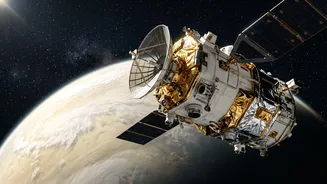
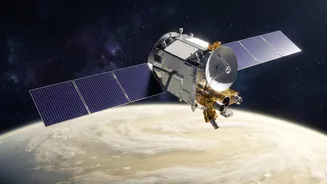
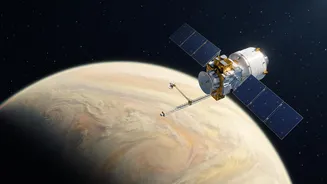
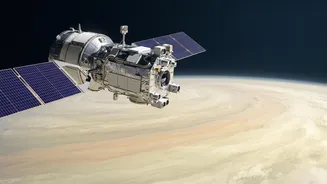
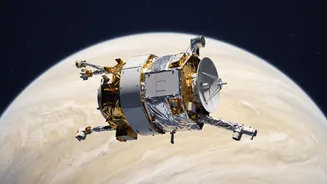
Following the historic successes of missions to the Moon and Mars, the Indian Space Research Organisation (ISRO) is setting its sights on Venus. The Venus Orbiter Mission, named Shukrayaan-1, received formal approval from the Union Cabinet in September
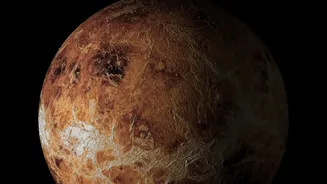
2024 and is slated for a launch in March 2028. This ambitious project represents India’s next major leap in planetary science, aiming to place a sophisticated orbiter into a long-term orbit around Venus. The primary goal is to perform a comprehensive investigation of the planet, from its mysterious surface, hidden beneath a thick haze, to the chemical makeup of its dense, corrosive atmosphere. This mission will not only enhance our understanding of Venus but also provide crucial insights into planetary evolution, helping scientists understand how Earth-like planets can turn into inhospitable worlds.
The Challenge of a Toxic World
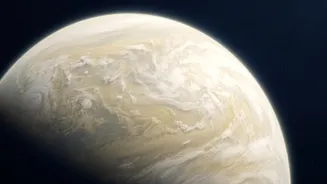
Exploring Venus is exceptionally difficult. The planet's atmosphere is over 90 times denser than Earth's and is composed almost entirely of carbon dioxide, creating an extreme greenhouse effect. This traps heat, leading to surface temperatures hot enough to melt lead. Blanketing the planet is a thick, unbroken layer of clouds made not of water, but of corrosive sulfuric acid. This impenetrable veil makes direct observation of the surface in visible light impossible. It’s within this toxic, high-pressure environment that Shukrayaan-1’s sensors must operate. The mission will study these clouds, the atmospheric chemistry, and the planet's super-rotating winds that whip around the globe far faster than the planet itself spins.
A Toolkit for Unveiling Secrets
To peer beneath the clouds and analyze the atmosphere, Shukrayaan-1 will carry a suite of around 19 advanced scientific instruments, or payloads, developed both in India and through international collaborations. A key instrument for atmospheric analysis is the Venus InfraRed Atmospheric Gases Linker (VIRAL), co-developed with Russia and France. This sensor is designed to study the composition of the atmosphere above the clouds, measuring the distribution of various gases. Other instruments, like a mass spectrometer and a spectro-polarimeter, will further investigate cloud properties, their composition, and the global circulation of the Venusian atmosphere. These tools will work in concert to create a detailed chemical and dynamic map of the planet's hostile sky, looking for clues about its past and present.
Searching for Venusian Mysteries
The data gathered by these sensors aims to solve some of the biggest puzzles about Venus. One major question is the potential past existence of water and why the planet evolved so differently from Earth. Another is the mystery of the “unknown UV absorber,” a substance in the clouds that absorbs ultraviolet radiation and is yet to be identified. Perhaps most tantalizingly, the VIRAL instrument is capable of detecting phosphine, a gas that was controversially detected in 2020 and is associated with anaerobic life on Earth. While the presence of life is a remote possibility, Shukrayaan's ability to confirm or deny the existence of phosphine in the Venusian clouds could be a landmark discovery. Additionally, instruments like the Lightning Instrument for Venus (LIVE) will search for electrical discharges, providing insight into atmospheric dynamics.