



Space is full of unbelievable sights and unsolved puzzles. But one of the most curious cosmic mysteries in recent memory was that of a planet that seemingly vanished into thin air. Now, astronomers believe they have finally solved the case.
A Landmark Discovery
The story begins
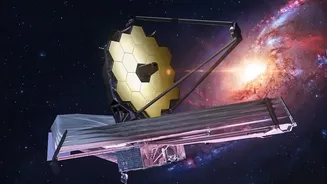
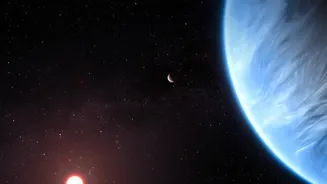
back in 2004. Using the incredible power of the Hubble Space Telescope, astronomers spotted a faint pinprick of light moving around the bright star Fomalhaut, located about 25 light-years from Earth. In 2008, it was announced as Fomalhaut b, one of the very first exoplanets to be directly photographed. It was a monumental achievement. For decades, planets outside our solar system were detected indirectly, through the wobble of their parent stars or the dimming of starlight as they passed in front. Seeing one was a game-changer, and Fomalhaut b quickly became one of the most intriguing objects in the sky.
A Cosmic Detective Story
However, as scientists continued to study Fomalhaut b, the story started to get strange. The object had several characteristics that didn't add up. For one, it was exceptionally bright in visible light, which is unusual for an exoplanet so far from its star. Yet, it gave off almost no heat in the infrared spectrum, which was bizarre for a large planet that should be warm. Furthermore, its orbit was highly unusual and appeared to be on a path that would eventually fling it out of the star system entirely. Astronomer András Gáspár noted that the object was 'doing things a bona fide planet should not be doing'. The mystery deepened.
The Vanishing Act
The final, definitive clue that something was amiss came when Gáspár and his colleague George Rieke analyzed Hubble images taken in 2014. They went back to look for the planet and found... nothing. The bright dot that had been tracked for years had completely disappeared. A planet can’t just evaporate. The team realised they weren't looking at a planet at all. The archival images showed that from 2004 to 2014, the object had not only faded but had also expanded, growing more diffuse over time before vanishing below Hubble's detection limit. This was not the behaviour of a solid world, but of something much more ephemeral.
The Great Cosmic Collision
The stunning conclusion published by the University of Arizona team was that Fomalhaut b was never a planet. Instead, what Hubble had witnessed was the direct aftermath of a titanic, exceedingly rare collision between two massive, icy bodies orbiting the star. Their models showed that a smashup between two objects, each likely about 200 kilometres wide, would create a vast, expanding cloud of extremely fine dust. This cloud, brilliantly illuminated by the light of Fomalhaut, was the 'object' that had been discovered. As the dust cloud expanded and dispersed into space, it grew fainter and larger, eventually becoming too thin to see. The 'missing planet' was actually a ghost—a temporary flare of light from a cosmic catastrophe.
A New Window Into Planet Formation
While the story of Fomalhaut b means there's one less exoplanet on the official list, the discovery is arguably even more exciting. Such massive collisions are a key part of how planetary systems are built and destroyed. They are thought to be common in the chaotic early days of a star system but are incredibly rare to witness. The odds of capturing such an event, which might only happen once every 200,000 years in a system like Fomalhaut, were astronomical. As Gáspár put it, 'We believe that we were at the right place at the right time'. Seeing the expanding debris cloud gives scientists a blueprint of how planets can destroy each other and provides a unique glimpse into the violent processes that shape the universe. It serves as a powerful reminder that the cosmos is a dynamic and evernding place, and that some of our greatest discoveries come from solving the puzzles it presents.