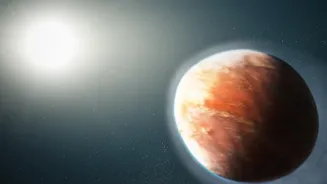

For years, astronomers have been puzzled by a strange gap in the cosmic census: a 'desert' where Neptune-sized planets orbiting close to their stars are mysteriously absent. Now, fresh observations are providing a compelling new explanation.
A Cosmic Ghost Town
Imagine looking
for cities on a map and finding plenty of small towns and huge megacities, but almost no medium-sized cities. That's what astronomers have encountered when searching for planets outside our solar system. They find an abundance of small, rocky 'super-Earths' and massive 'hot Jupiters' that orbit their stars in a blistering-hot embrace. But in between these two extremes, there's a noticeable void known as the 'Neptunian Desert'. This is a region extremely close to a star where planets the size of our own Neptune are suspiciously rare. For years, the leading theory was that the intense radiation from the parent star would simply boil away the gassy atmospheres of any Neptune-sized worlds that strayed too close, leaving behind only their smaller, rocky cores.
The Case of the Vanishing Planet
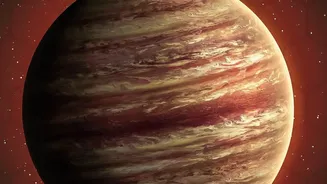
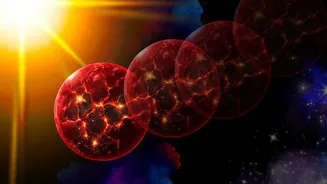
A recent discovery has added a dramatic new twist to this astronomical detective story. Astronomers using NASA's Transiting Exoplanet Survey Satellite (TESS) had been tracking a 'hot Jupiter' named TOI-2535 b, a gas giant orbiting its star 1,000 light-years away. They observed it regularly between 2019 and early 2026. But its behaviour was odd. The planet's transits—the slight dimming of its star's light as it passed in front—were not arriving like clockwork. Sometimes it was up to six hours early, other times six hours late. Then, in March 2026, it seemed to vanish altogether; TESS could no longer detect its transits.
An Unseen Cosmic Dance Partner
Rather than concluding the planet had been destroyed, scientists proposed a different culprit: an unseen neighbour. New research suggests TOI-2535 b isn't alone. It's being tugged on by the powerful gravity of a second, as-yet-undetected planet in the same system. This gravitational interference is causing TOI-2535 b's orbit to wobble dramatically, like a spinning top that's been nudged. Over seven years of observation, this wobble became so extreme that it tilted the planet's orbital plane from our point of view on Earth. It no longer crosses in front of its star from our perspective, hence the 'disappearance'. This is the first time astronomers have directly witnessed a planet's transits cease due to such a strong interaction.
Solving the Broader Puzzle
This discovery provides a compelling new piece of the Neptunian Desert puzzle. While the intense radiation from a star is certainly a factor, it may not be the only reason these planets are missing. The case of TOI-2535 b shows that strong gravitational interactions between planets can significantly alter their orbits over time. This suggests another mechanism for the desert's existence: planets that might have once been stable, hot Neptunes could be thrown into chaotic, tilted orbits by their neighbours. Over millions of years, these gravitational tugs could even fling them out of their systems entirely or send them spiraling into their host star. The universe, it seems, is less like a predictable clock and more like a dynamic, interactive system.