
The Fiery End of a Sun-Like Star
Most stars, including our own Sun, will end their lives not with a bang, but with a prolonged sigh. After billions of years of fusing hydrogen into helium, a star like the Sun runs low on fuel. Its core contracts and heats up, while its outer layers swell
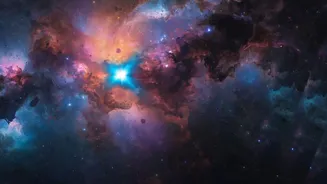
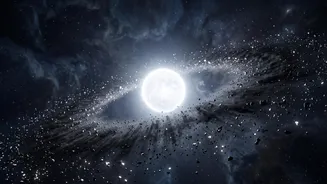
dramatically, transforming it into a 'red giant'. This phase is catastrophic for any nearby worlds. A red giant can grow so large that it engulfs its inner planets. In our solar system's distant future, Mercury, Venus, and likely Earth will be consumed when the Sun enters this stage. After puffing off its outer atmosphere to form a beautiful 'planetary nebula,' all that remains is the star's incredibly dense, hot core: a white dwarf. This stellar remnant is essentially the ghost of the star that was, slowly cooling over trillions of years.
A Planet That Shouldn't Be There
Given this destructive process, finding a planet orbiting close to a white dwarf is a puzzle. Any 'first-generation' planet—one that formed with the original star—would have been destroyed or pushed into a much more distant orbit. Yet, astronomers have found hints of planets in these unlikely places. One such candidate orbits a white dwarf known as HS 0209+0832, located about 270 light-years from Earth. This system became a 'cold case' after its initial observation by the Hubble Space Telescope in 1999 revealed about 100 unidentifiable chemical signatures. The mystery lingered for decades until new analysis provided a startling explanation.
Cosmic Forensics: The Chemical Clues
By re-examining the old Hubble data with modern chemical databases, a team led by astronomers from the University of Warwick made a breakthrough. They identified the strange signatures as belonging to heavy elements, most notably niobium. The atmosphere of this white dwarf contained over 1,000 times more niobium than is found in our Sun. This is significant because elements like niobium are forged inside stars during their final, dying phases. The discovery suggests that the material falling onto the white dwarf isn't from a surviving first-generation planet. Instead, the evidence points to a 'second-generation' planet—a world formed from the ashes and debris the star cast off as it died.
The Phoenix Planet Hypothesis
The theory is that after the star sheds its outer layers, the ejected gas and dust can form a new protoplanetary disk around the white dwarf. From this disk of recycled stellar material, new planets can coalesce. This makes them 'second-generation' worlds. The unusual chemical composition, rich in elements created during the star's death, is the key clue. Data from NASA's TESS satellite added more weight to the theory, detecting a regular dip in the white dwarf's brightness every 4.4 days. This is consistent with a Jupiter-sized gas giant orbiting extremely close to the star, losing its atmosphere to the intense heat. If confirmed, it would be the first time a second-generation planet has been identified around a white dwarf, a much more common stellar remnant than the pulsars where such planets were previously suspected.
Why This Discovery Matters
Finding a potential 'phoenix' planet completely changes how we view the lifecycle of planetary systems. It suggests that stellar death isn't the final chapter, but merely the start of a new one. It implies that planetary formation is a more resilient and recurring process than previously believed. While the candidate planet around HS 0209+0832 is a gas giant being blasted by its hot star, the discovery opens up fascinating possibilities. As a white dwarf cools over billions of years, it provides a stable, long-lasting source of energy. A rocky planet that forms in this second generation could potentially lie within a stable habitable zone for a far longer time than Earth has existed, perhaps offering a future chance for life to emerge long after the parent star has died.