


The Holy Grail of Spaceflight
For decades, rockets were single-use machines. The most expensive parts would burn up in the atmosphere or crash into the ocean. SpaceX revolutionised the industry with its Falcon 9 boosters, which could land themselves on drone ships or landing pads
and be flown again. This was a massive leap forward, but it was only the first step. True, rapid reusability—re-launching a rocket in hours, not weeks—remains the ultimate goal. Achieving this would slash the cost of accessing space and make interplanetary travel economically feasible.
The Problem with Landing Legs
The Falcon 9 lands on four deployable legs. While effective, these legs represent a significant trade-off. They add mass to the rocket that has to be carried all the way to space and back. Every kilogram dedicated to landing gear is a kilogram that can't be used for fuel or payload, like satellites or astronauts. For the colossal Super Heavy booster—the first stage of the Starship system—the landing legs would need to be massive, heavy, and complex to safely support the vehicle's weight. This 'dead weight' is a penalty on every single launch.
Enter 'Mechazilla': The Catching Tower
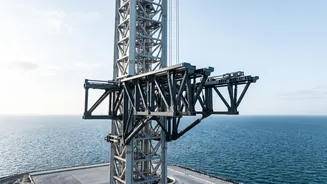
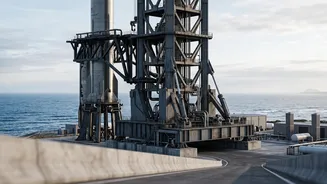
SpaceX's radical solution is to get rid of the booster's landing legs entirely. Instead, the launch tower itself will catch the returning booster. Nicknamed 'Mechazilla', the massive launch integration tower is equipped with two huge, powerful arms often called 'chopsticks'. As the Super Heavy booster returns from its mission, it will perform a final engine burn to slow itself down and guide itself between these arms. The arms then close in and grab the booster by its super-strong grid fins before it touches the ground.
Trading Rocket Mass for Ground Complexity
This is the essence of the strategy: moving complexity from the flying vehicle to the ground. Rocket design is constrained by mass, but ground systems are not. By removing the landing legs, the booster becomes lighter and more efficient, increasing its payload capacity. All the heavy, complex hardware for landing—massive hydraulic systems, sensors, and robust structural components—is built into the launch tower instead. The tower can be over-engineered for strength and reliability without paying a penalty in launch performance.
The 'Under an Hour' Turnaround Dream
The tower-catch strategy is about more than just saving weight; it's about speed. Catching the booster places it directly back on the launch mount, ready for immediate servicing and repositioning. This eliminates the entire process of landing on a separate pad, securing the rocket, transporting it horizontally, and then lifting it back onto the launch mount with a crane. Elon Musk has stated the goal is to be 'ready to refly in under an hour'. This incredible turnaround time is essential for SpaceX's ambitious plans, which include launching multiple tanker flights to refuel a single Mars-bound Starship in orbit.
An Audacious, High-Stakes Gamble
The maneuver is undeniably one of the most ambitious in aerospace history. The precision required is immense; the booster must navigate itself perfectly between the arms while battling atmospheric conditions. The stakes are incredibly high. A failure wouldn't just mean the loss of the booster; it could potentially destroy the entire launch tower, the single most critical piece of ground infrastructure. It is a high-risk, high-reward approach that is characteristic of SpaceX's engineering philosophy. Success would fundamentally change the economics of spaceflight, while failure would be a spectacular setback.