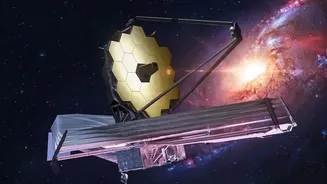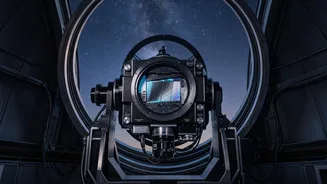



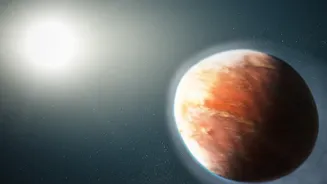


The search for life beyond Earth is one of humanity's greatest quests. While powerful telescopes like the JWST gather faint light from distant worlds, the true key lies in the sophisticated software that deciphers what that light is telling us.
The Cosmic Chemical Test
To find
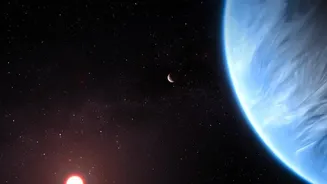
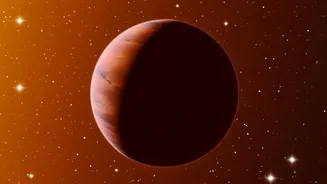
life, we first need to know what to look for. In astrobiology, scientists search for 'biomarkers' or 'biosignatures'—substances that provide evidence of life. On Earth, life fundamentally alters our atmosphere, filling it with gases like oxygen, methane, and ozone. These gases could also be strong indicators of biological processes on a distant exoplanet. When a planet passes in front of its host star from our perspective, a tiny fraction of the starlight filters through the planet's atmosphere. Different gases in that atmosphere absorb light at very specific wavelengths, or colors. This process leaves a unique pattern of dark lines, an absorption spectrum, which acts like a chemical fingerprint, telling us which molecules are present millions of light-years away.
Capturing a Planet’s 'Breath'
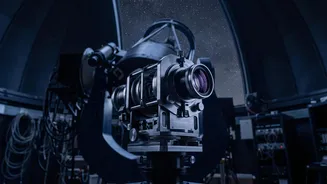
The technique used to capture these fingerprints is called transmission spectroscopy. Telescopes, most notably the James Webb Space Telescope (JWST), are pointed at a star as one of its known exoplanets transits. During this brief window, which may only last a few hours, the telescope measures the incredibly faint dimming of starlight caused not just by the planet itself, but by its thin atmospheric layer. The data gathered is a spectrum—a breakdown of light by wavelength. Each dip in the spectrum corresponds to a wavelength of light absorbed by a molecule in the planet's atmosphere. The challenge is immense; the signal from an Earth-sized planet's atmosphere is extraordinarily weak, and the data is often filled with noise from the star and the instrument itself.
The Rise of the Algorithm
This is where biomarker detection algorithms become essential. Manually sifting through the massive datasets produced by telescopes is inefficient and prone to error. The signals are so faint and the potential combinations of gases so vast that human analysis alone is not enough. Instead, scientists use sophisticated algorithms, including artificial intelligence and machine learning (ML), to analyze the spectral data. These computational tools are designed to do what the human eye cannot: detect the faintest, most complex patterns hidden within noisy data. They can compare an observed spectrum against thousands of simulated atmospheric models to find the best fit.
Training AI to Find Life
A machine learning model must first be trained to be effective. Scientists create vast libraries of simulated planetary spectra. They generate models of what an atmosphere might look like with certain combinations of gases—some with biomarkers, some without—under various conditions. The algorithm, often a type of neural network, is then fed this training data, learning to associate specific patterns in the spectrum with the presence of target molecules like methane or oxygen. This allows the model to become highly adept at classifying real-world observations, determining the probability that a given spectrum contains a biosignature. These models can achieve high accuracy, significantly reducing the area and time needed for searches and flagging the most promising candidates for further study.
Challenges and the Path Forward
The process is not without its difficulties. A significant challenge is avoiding 'false positives'. A gas like methane can be produced by geological activity as well as by life, so context is crucial. Furthermore, some studies show that the detection of a gas can depend heavily on the models used for comparison; expanding the range of models can sometimes make a potential biosignature detection disappear. This makes it vital for scientists to refine their models and be cautious about claims. The goal is to build algorithms that not only detect a specific gas but also help determine if its presence is consistent with a living world. The future of astrobiology will rely on an ever-closer partnership between next-generation telescopes and even smarter AI.