



The Source: A Race Against Time
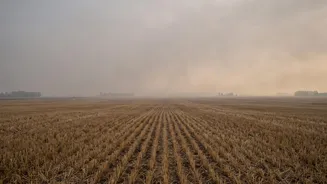
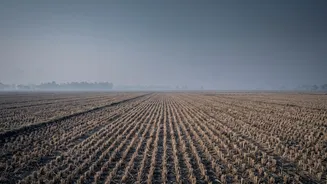
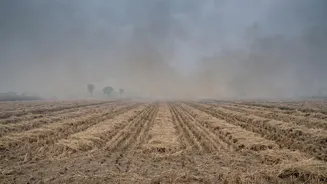
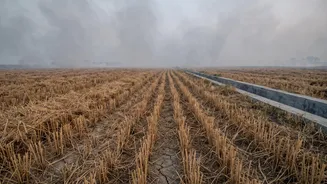
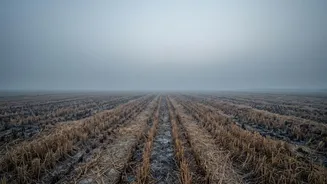
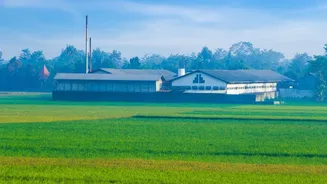
The journey begins in the fertile fields of Punjab, Haryana, and western Uttar Pradesh. After the rice harvest in October and November, farmers have a very short window to clear their fields before planting the next winter crop, primarily wheat. Faced
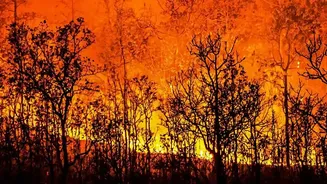
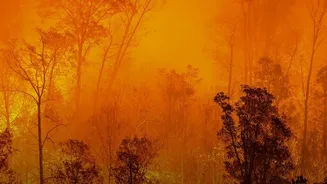
with time and cost pressures, burning the leftover crop stubble is often the fastest and cheapest method. Mechanised harvesting, which leaves taller stalks, has made this practice more common. This isn't a few isolated fires; it's a massive, coordinated event where thousands of fields are set ablaze, releasing immense quantities of pollutants like particulate matter (PM2.5 and PM10), black carbon, carbon monoxide, and nitrogen oxides into the atmosphere.
The Initial Lift: Riding the Heat
The intense heat from these fires is the engine of the smoke's ascent. Just like a hot air balloon, the heated air and smoke are lighter than the surrounding cooler air, causing them to rise. This updraft pushes the plume of pollutants high into the lower atmosphere, often several hundred metres to a few kilometres above the ground. This initial lift is crucial, as it allows the smoke to escape the surface level and enter a different atmospheric layer where it can be transported over long distances.
The Atmospheric Highway: Winds and Inversion
Once aloft, the smoke enters an atmospheric highway. During the post-monsoon period, wind patterns shift. The prevailing winds become northwesterly, blowing directly from the agricultural heartlands towards the Indo-Gangetic Plain, including Delhi. These winds act as a conveyor belt, carrying the polluted air mass hundreds of kilometres. Making matters worse is a phenomenon called temperature inversion. As winter approaches, the ground cools rapidly at night, making the air near the surface colder than the air layer above it. This warmer layer acts like a lid, trapping the cold, dense, and now smoke-filled air below it, preventing it from dispersing vertically. The pollutants are effectively stuck in a shallow layer of the atmosphere, concentrating as they travel.
The Chemical Kitchen: A Toxic Transformation
The smoke doesn't just travel; it transforms. During its journey, the primary pollutants released from the fires—such as nitrogen oxides (NOx) and volatile organic compounds (VOCs)—cook in the atmosphere. Triggered by sunlight, these chemicals react with each other to form more dangerous secondary pollutants. These include ground-level ozone and, most significantly, secondary particulate matter. This chemical evolution makes the smog more complex and toxic by the time it reaches urban centres. The once-visible smoke becomes a complex aerosol cocktail, a key ingredient in the dense, vision-obscuring haze.
The Final Stop: Stagnation and Accumulation
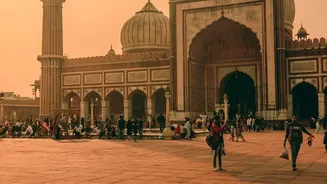
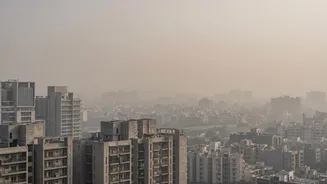
The final stage of the journey is descent and stagnation over cities like Delhi. The region's geography plays a critical role. Landlocked and partially encircled by the Himalayas and Aravalli hills, the area acts like a natural bowl that traps air. As the pollutant-laden winds reach this basin, wind speeds often decrease, allowing the air mass to stagnate. The trapped smoke and secondary pollutants begin to descend and concentrate, drastically increasing pollution levels on the ground. This imported pollution then mixes with the city's own local emissions from vehicles, industry, and construction dust, creating the severe smog episodes that define North India's winter. This combination of long-range transport and local sources leads to the dangerously high air quality index (AQI) readings seen each year.