


A New Era of Discovery
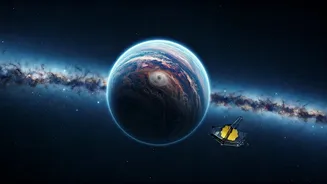
In the vast cosmic ocean, the search for planets outside our solar system—known as exoplanets—has shifted from mere detection to detailed characterisation. The James Webb Space Telescope is at the forefront of this revolution. Scientists are no longer
just asking, "Is there a planet?" but rather, "What is that planet like?" The recent profiling of water vapour on a far-off world marks a pivotal moment in this quest, transforming our ability to understand the building blocks of planets beyond our own cosmic neighbourhood. This isn't just about finding any single molecule; it's about painting a complete picture of an alien environment hundreds of light-years from Earth.
How to 'See' Water from Light-Years Away
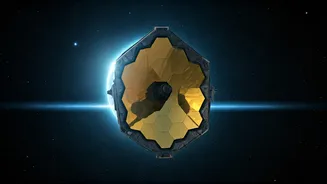
Detecting water on a world you can't even visit sounds like science fiction, but the method is remarkably elegant. It's called transit spectroscopy. When an exoplanet passes in front of its host star from our point of view, a tiny fraction of the starlight filters through the planet's atmosphere. The chemicals in that atmosphere absorb specific colours, or wavelengths, of light. For JWST, which is exquisitely sensitive to infrared light, water molecules leave a very distinct 'fingerprint' on the light that reaches the telescope's detectors. By analysing which parts of the light spectrum are missing, astronomers can confidently identify the presence of water vapour, and even other compounds like methane and carbon dioxide.
More Than Just a Water World
The term 'profiling' is key. JWST isn't just giving a simple 'yes' or 'no' on water. Its powerful instruments can discern much more, creating a detailed profile of the atmosphere. For example, in the case of the fascinating exoplanet WASP-107b, a 'fluffy' world almost the size of Jupiter but with a much lower mass, Webb didn't just find water. It also detected sulphur dioxide and clouds made of silicate particles—essentially, sand. This level of detail helps scientists understand the planet’s climate and chemical processes, revealing a world with a dynamic and complex atmosphere. It’s a far cry from a simple blue marble; these are exotic worlds with weather systems and chemistry unlike anything in our solar system.
Managing Expectations: Not Earth 2.0
The discovery of water inevitably raises the question of habitability and life. However, it's crucial to put these findings in context. Many of the planets where Webb has found water are not Earth-like. Take GJ 486 b, a rocky exoplanet with a scorching surface temperature of about 430 degrees Celsius. While Webb detected hints of water vapour, scientists are cautious, noting it could even be coming from the cool spots on the host star itself. Another example is K2-18 b, a potential 'Hycean' or ocean world, which has shown evidence of a water-rich interior but whose thick atmosphere and vast ocean might create pressures and temperatures far from friendly to life as we know it.
A Stepping Stone to Habitable Worlds
While these initial discoveries may not have pinpointed a true Earth twin, they serve a vital purpose: they are a proof of concept. Each detection of water, methane, or carbon dioxide on a hot Jupiter or a mini-Neptune fine-tunes the techniques astronomers will use to study smaller, cooler, rockier worlds in the future. These planets are proving that JWST has the power to read the atmospheric diaries of alien worlds. The ultimate goal remains to point this incredible telescope at a small, rocky planet in the 'Goldilocks Zone' of its star—where conditions are just right for liquid water to exist on the surface—and apply these same powerful techniques.