




The Challenge of a Fiery Return
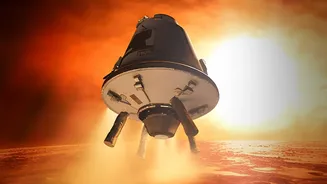
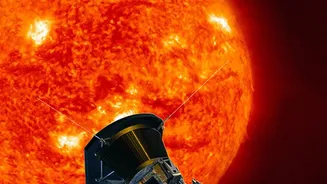
Bringing a spacecraft back to Earth, or landing it on a planet with an atmosphere like Mars, is one of the most violent events in engineering. A probe hits the upper atmosphere at hypersonic speeds, often more than 25 times the speed of sound. This rapid
compression of air generates immense heat—reaching thousands of degrees Celsius—and creates powerful aerodynamic drag forces that slow the vehicle down. Traditionally, space agencies have used rigid, heavy heat shields. These have worked, but they have a major limitation: their size is restricted by the diameter of the rocket fairing they launch in. This size constraint limits the weight of the payload they can deliver, posing a significant hurdle for ambitious future missions, such as landing heavy cargo or human habitats on Mars.
A Bigger Brake for Bigger Landings
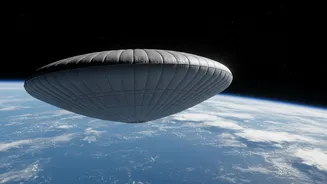
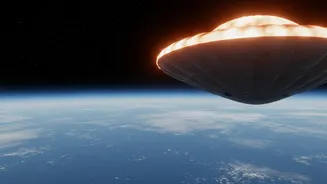
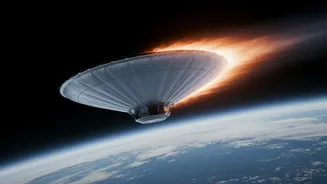
This is where the inflatable shield, known formally as a Hypersonic Inflatable Aerodynamic Decelerator (HIAD), comes in. The core idea is simple: a bigger brake creates more drag. By packing a large shield into a small volume for launch and then inflating it just before re-entry, a spacecraft can dramatically increase its surface area. This larger surface catches more atmospheric particles higher up, starting the deceleration process earlier and more gently. It allows the vehicle to slow down with greater efficiency and stability, reducing the peak heating and forces experienced. This technology is a game-changer because it breaks the size limitations of rocket fairings, enabling the potential to land much heavier payloads safely.
Not a Balloon: The Inflatable Structure
The term 'inflatable' can be misleading. This is not a simple party balloon. The underlying structure is a series of stacked rings, or tori, woven from incredibly strong synthetic polymers like Kevlar—materials that, pound for pound, can be stronger than steel. These rings are designed to be flexible enough to be folded tightly for launch but become incredibly rigid and stable when inflated with nitrogen gas. This robust internal frame gives the shield its mushroom or cone shape and provides the structural integrity needed to withstand the immense aerodynamic pressures of re-entry, which can be equivalent to stacking a hundred cars on the structure.
The Secret in the Outer Weave
Surviving the force is only half the battle; surviving the heat is the other. The inflatable structure itself is protected by a sophisticated, flexible Thermal Protection System (TPS). The outermost layer of this system is a fabric woven from ceramic fibers, specifically silicon carbide. This material can be spun into a yarn and woven on industrial looms, much like denim jeans, but it can withstand temperatures of up to 1,600 degrees Celsius. This ceramic fabric acts as the first line of defence, reflecting and enduring the most intense heat. Just beneath this outer skin are layers of high-tech insulation designed to stop that heat from reaching and compromising the inflatable structure within.
Proof in the Plunge
This technology is not just theoretical. In November 2022, NASA successfully demonstrated it with the Low-Earth Orbit Flight Test of an Inflatable Decelerator (LOFTID) mission. A 6-meter (about 20-foot) diameter shield was launched into orbit, inflated, and sent plunging back through Earth's atmosphere at over 29,000 kilometres per hour (Mach 25). It survived the intense heat and deceleration forces, splashing down safely in the Pacific Ocean where it was recovered in excellent condition. The test was declared a huge success, proving that the HIAD technology is ready to be used for future missions. It confirmed that both the thermal and structural systems performed as designed, protecting the vehicle throughout its hypersonic journey.
The Future of Planetary Landings
The success of LOFTID opens up a new era for space exploration. For Mars, it means the ability to land heavier robotic labs, equipment for future human missions, and access higher-altitude landing sites that are currently unreachable. For Earth, it could enable the cost-effective return of launch vehicle components for reuse, or bring back materials manufactured in space. European agencies are also developing similar technologies, with projects like ICARUS aiming to demonstrate their own inflatable shields by 2028. By solving the dual problem of size and weight, inflatable atmospheric shields provide an elegant solution that makes bigger and bolder missions across the solar system more feasible than ever before.